
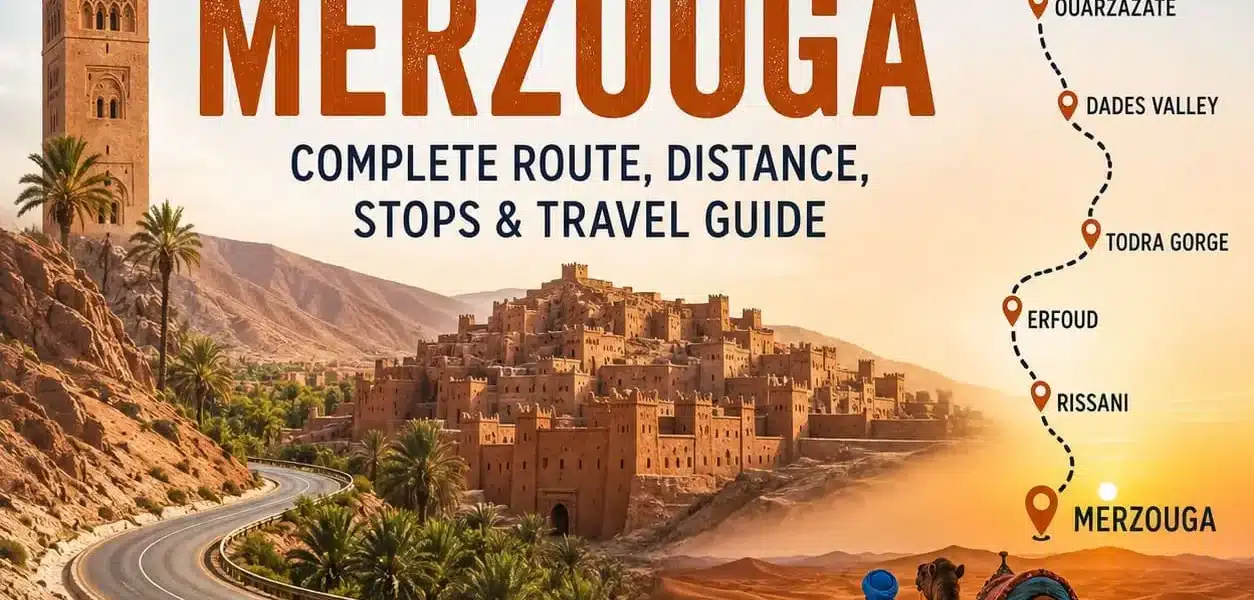
Marrakech to Merzouga Road Trip Guide: Route, Distance, Stops & Travel Guide
Planning a journey from Marrakech to Merzouga is about much more than reaching the Sahara Desert. Along the way, the road crosses the dramatic High Atlas Mountains, ancient kasbahs, the UNESCO-listed Ait Ben Haddou, the landscapes of Ouarzazate and Skoura, the Dades Valley, Todra Gorge, and the rocky desert plains surrounding Erfoud and Rissani before arriving at the golden dunes of Erg Chebbi.
Most people start planning this trip by typing a distance into a maps app, seeing a number somewhere around eight or nine hours, and concluding they can do it in a day. That is the first thing worth correcting. The drive is possible in a day. The journey is not, because the road from Marrakech to Merzouga passes through most of the reasons you came to southern Morocco in the first place.
The sequence runs like this: Marrakech, then up over the High Atlas via the Tizi n’Tichka, down to Ait Ben Haddou and Ouarzazate, east through the Skoura palm oasis and the M’Goun valley, into the Dades Valley, on through Tinghir and the Todra Gorge, then across increasingly empty ground to Erfoud, Rissani and finally Merzouga on the western edge of Erg Chebbi. In roughly 560 kilometres you go from a walled city at 450 metres, over a pass above 2,200 metres, through irrigated oases and two of Morocco’s most dramatic canyons, and out onto a sand sea. Very few road journeys anywhere change character as comprehensively as this one.
This guide covers the distance, realistic timings, every stop worth knowing about, two workable itineraries, and the trade-offs between travelling privately, driving yourself, or using public transport.
Marrakech to Merzouga is roughly 550 to 570 km by road, around eight to nine hours of driving without stops. The standard route runs over the Tizi n’Tichka pass to Ait Ben Haddou and Ouarzazate, east through the Dades and Todra gorges, then via Erfoud and Rissani to Merzouga and the Erg Chebbi dunes. Most travellers take three or four days to split the journey.
Marrakech to Merzouga at a Glance
| Detail | What to expect |
|---|---|
| Route | Marrakech, Tizi n’Tichka, Ait Ben Haddou, Ouarzazate, Skoura, Dades, Todra, Erfoud, Rissani, Merzouga |
| Approximate road distance | Around 550 to 570 km one way, depending on detours taken |
| Direct driving time | Roughly 8 to 9 hours behind the wheel in good conditions |
| Realistic travel time with stops | Two days each way at a sensible pace |
| Recommended duration | 3 days minimum for a round trip, 4 days for comfort |
| Main landscapes | High Atlas peaks, pre-Saharan plateau, palm oases, red gorges, sand dunes |
| Main attractions | Ait Ben Haddou, Kasbah Taourirt, Dades Gorge, Todra Gorge, Rissani souk, Erg Chebbi |
| Best travel style | Private or small-group vehicle with a driver who knows the road |
| Best season | March to May and September to November |
Direct driving time is not travel timeThe eight-to-nine-hour figure assumes continuous driving with brief fuel stops. Add lunch, two or three sightseeing stops, a walk at a gorge and the usual delays on the mountain section, and the same distance becomes two comfortable days. Roadworks on the Tichka, snow in winter, livestock on rural roads and simple traffic around Marrakech all move the number. Plan with a margin rather than to the minute.
How Far Is Marrakech from Merzouga?
By road, approximately 550 to 570 kilometers. The variation is real rather than sloppy: the exact figure depends on whether your route detours to Telouet after the pass, whether you drive up into the Dades Gorge or stop at its mouth, and which of the two approaches to Merzouga you take at the end.
You will see other figures quoted, commonly 546 km or 560 km. They measure slightly different lines between two points that are themselves loosely defined, since “Merzouga” can mean the village, the hotel strip at the edge of the sand, or a camp several kilometers inside the erg.
Straight-line distance is a different matter entirely and worth ignoring for planning purposes. As the crow flies the two places are only around 350 kilometres apart. The road is substantially longer because it has to get around the High Atlas rather than through it, then follow the valleys east. That gap between map distance and road distance is the single most common reason travelers underestimate this journey.
How Long Does It Take to Travel from Marrakech to Merzouga?
There is no single answer, because the question conflates two different things: how long the driving takes, and how long the journey is worth taking. Four scenarios cover almost everyone.
The direct drive
Eight to nine hours of continuous driving, more if the Tichka is slow. It is done, and it is generally a poor idea. Roughly two of those hours are spent on a mountain pass with several hundred bends, and if you arrive at the dunes at dusk having stopped only for fuel, you will pay the full cost of the route but collect none of the benefit.
Two days
Two days works as a one-way transfer with a single overnight, typically in the Dades Valley or Tinghir. It does not work as a round trip: that means around eighteen hours in a vehicle across two days, leaving almost nothing at the destination. Operators advertising “2-day desert tours” from Marrakech are almost always going to Zagora, a genuinely nice trip to a much smaller dune field rather than a shortcut to Erg Chebbi.
Three days
This is the standard round trip and the shortest sensible option. Two nights: one in the Dades Valley, one at a desert camp. You get the Atlas crossing, Ait Ben Haddou, Todra Gorge, a camel trek, a night in the dunes and a sunrise. The cost is a long final day, usually nine to ten hours back to Marrakech.
Four days
The same route with the pressure taken out. Three nights instead of two, with daily driving down to roughly three to five hours, and enough slack to stop at Skoura, walk further into Todra, and keep a full morning in the desert rather than leaving after breakfast.
A useful rule of thumb: count nights, not days. One night in the Sahara is the minimum to make the drive worth it. Two nights on the road, one of them in the desert, is a three-day trip. Three nights, one of them in the desert, is a four-day trip.
What Is the Best Route from Marrakech to Merzouga?
There is effectively one main route, which is less a limitation than a consequence of geography. The High Atlas runs across the country, with the Tizi n’Tichka as the practical crossing, and beyond it the valleys channel you east. Almost every itinerary follows the same line and differs only in what it stops for.
- Marrakech Departure, usually between 7 and 8am
- Tizi n’Tichka Pass and the High Atlas Roughly 2.5 to 3.5 hours of mountain driving
- Ait Ben Haddou UNESCO ksar, the route’s essential stop
- Ouarzazate Lunch, Kasbah Taourirt, film studios
- Skoura Palm Oasis and Kasbahs
- Valley of Roses (Kelaat M’Gouna) Seasonal, brief for most travellers
- Dades Valley and Gorge Common overnight, roughly two-thirds of the way
- Tinghir and Todra GorgeCanyon walk, oasis viewpoint
- ErfoudFossils, dates, short break
- Rissani Historic souk town, market days
- Merzouga and Erg Chebbi The destination, minimum one night
You do not need to stop at all eleven, and nobody does. A three-day itinerary gives proper time to four or five, and the skill in planning is choosing which. The one alternative worth knowing is the southern route via Agdz and Zagora down the Draa Valley, sometimes used on the return leg to avoid retracing the same road.
Best Stops Between Marrakech and Merzouga
Tizi n’Tichka Pass and the High Atlas Mountains
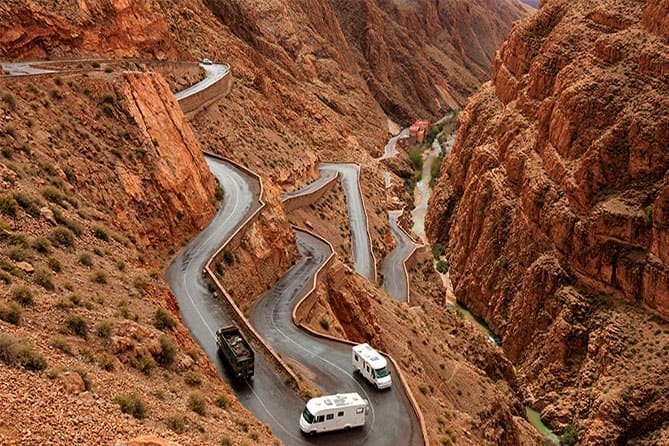
The highest paved pass in Morocco, crossing the High Atlas at roughly 2,260 meters. The road climbs out of the Haouz plain through walnut and almond terraces, then spends an hour on bare rock with Amazigh villages built from the same earth they stand on. The temperature drop between Marrakech and the summit is noticeable in any season, and there can be snow at the top in winter. Use the established viewpoints and cafe terraces rather than stopping on the verge: this is a working freight road with blind bends, and any driver who knows it already has two or three safe pull-ins in mind. A short detour after the pass reaches Telouet and its half-ruined Glaoui kasbah.
Ait Ben Haddou
A ksar is a fortified village, and this is the best-preserved one most travellers will see: earth towers rising in tiers above a shallow riverbed behind a defensive wall, with a communal granary at the summit. The material is rammed earth mixed with straw, which is why it glows the colour of the hill behind it and why it needs constant repair. UNESCO-listed since 1987.
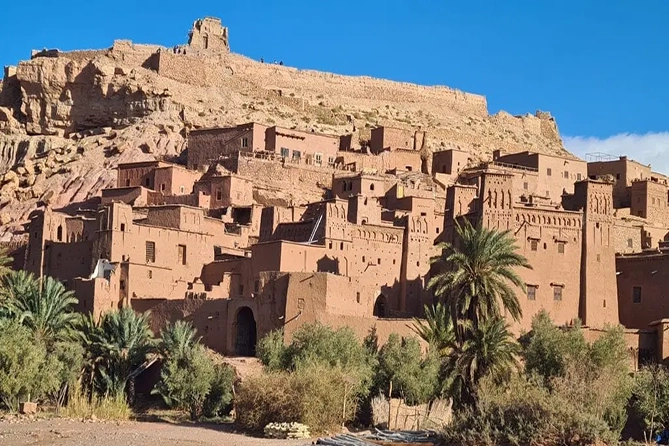
Allow at least ninety minutes. The common mistake is to park, cross to the viewpoint, take the standard shot and leave within half an hour, missing the earth lanes, the carved doorways and the twenty-five-minute climb to the granary that opens up the whole Ounila valley. Its film history is more supporting context than the reason to come.
Ouarzazate
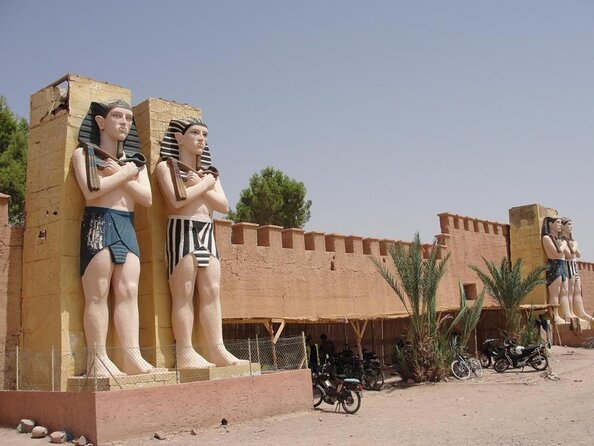
The gateway to southern Morocco in a literal sense: roads from the Draa, the Dades, the Atlas and the Anti-Atlas all meet here, which is how a garrison post became the region’s administrative center. Kasbah Taourirt is the main historic site, a partly restored Glaoui property of staircases, painted ceilings, and roof terraces, and quieter than Ait Ben Haddou. Atlas Film Studios sits just outside town. Three-day trips usually stop for lunch and an hour; four-day trips sometimes use Ouarzazate as an overnight on the return, since it has the widest hotel choice between Marrakech and the desert.
Skoura Palm Oasis
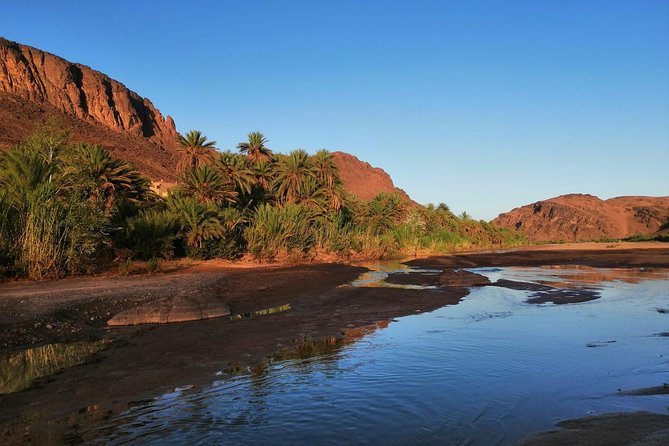
Half an hour east of Ouarzazate, the ground turns abruptly green. Skoura is a large palmeraie where date palms shade olives, almonds, and figs on small irrigated plots fed by hand-maintained channels, with kasbahs standing among them in varying states of repair. Amridil, the best known, is complete enough to show clearly how these fortified family houses worked. The appeal is the contrast: after an hour of open stony plateau, you are walking under shade with water beside the path. Several kasbahs operate as guesthouses, which makes Skoura a good choice for travelers wanting something slower. On a tight three-day schedule, it is usually just a green blur from the car.
Valley of Roses
Between Skoura and Boumalne Dades the road runs through the M’Goun valley, centred on Kelaat M’Gouna. Damask roses grow here in hedgerows along irrigation channels and field boundaries rather than in ornamental beds, supporting a local industry in rose water, distilled oil and cosmetics. Be realistic about timing: the blooming period is short, typically late April into May depending on the year and marked by a rose festival. Outside that window you will see the valley, the mountains and the shops selling rose products, but not fields of flowers.
Dades Valley
Boumalne Dades sits at the mouth of a valley cutting north into the High Atlas. The lower section is agricultural, a green ribbon of fields and poplars with kasbahs on the slopes. Higher up the rock takes over: a stretch of weathered sandstone formations locals call monkey fingers, then the tight hairpins climbing the gorge wall that appear in most photographs of the region.
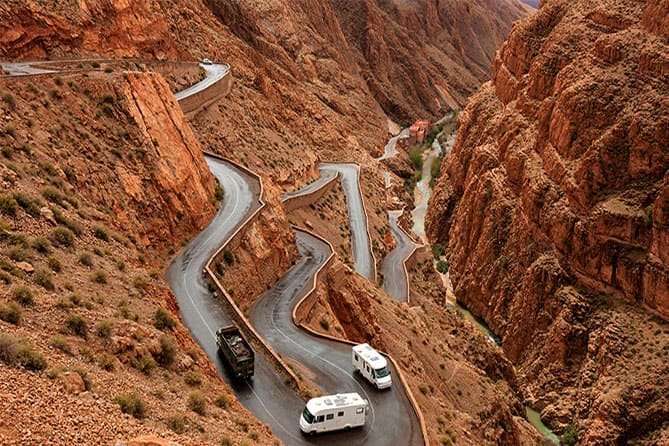
Almost every Marrakech to Merzouga itinerary includes an overnight here, for good practical reasons. It falls roughly two-thirds of the way, the valley is full of kasbah hotels and guesthouses, and evenings are cool at this altitude even in summer. Staying means waking up inside the scenery rather than arriving in it at the end of a long day.
Todra Gorge
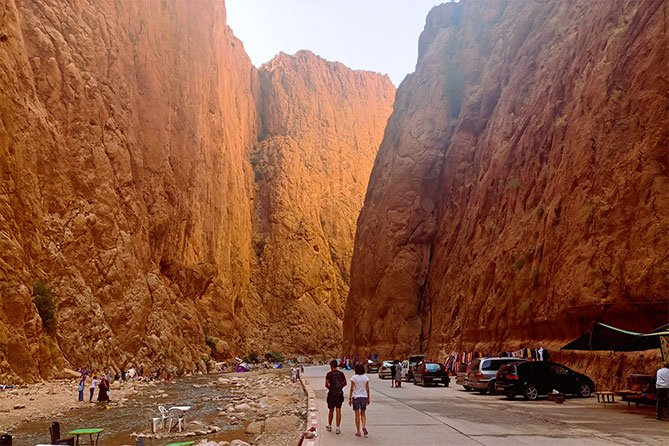
Reached through Tinghir and its long palm oasis, Todra is the narrow counterpart to the broad Dades. At its tightest the limestone walls close to a corridor a few tens of meters wide with several hundred meters of rock either side, a shallow stream, and a road along the bottom. Most people walk the flat section between the cliffs, half an hour at an easy pace in ordinary shoes. Beyond that there are longer valley walks, marked trails, and bolted climbing routes on both walls, so for travellers interested in nature or hiking, this is where an extra hour pays off most visibly.
Erfoud
Erfoud is the last town of any size before the dunes and serves largely as a supply point for the Tafilalt oases. The surrounding hills are rich in marine fossils from a period when this region lay under a shallow sea, and local workshops cut and polish orthoceras and goniatite into tabletops and small objects, usually with the process open to visitors. Erfoud also sits in one of Morocco’s major date-producing regions, with the October harvest a significant local event. It rarely justifies an overnight when Merzouga is under an hour further on, so treat it as a break in the drive.
Rissani
Rissani carries far more history than its size suggests. It stands near the site of Sijilmassa, a medieval caravan city that was for centuries a northern terminus of trans-Saharan trade, and it is closely associated with the origins of the Alaouite dynasty. The souk is the main draw, operating on set days, traditionally Sunday, Tuesday and Thursday. It is a working regional market rather than a tourist one, dealing in livestock, dates by the sack, tools and textiles, which also means asking before photographing people is basic courtesy rather than an optional nicety. Rissani is the home of medfouna, a stuffed flatbread baked to order in a wood oven and filled with spiced meat, onion and almonds.
Merzouga and Erg Chebbi
These are two different things, and the distinction matters when you book. Merzouga is a village on the western edge of the sand, with hotels, shops and the road. Erg Chebbi is the dune field itself, a sand sea roughly 25 to 30 kilometres long with the tallest dunes well over a hundred metres. A hotel “in Merzouga” sits on the tarmac looking at the dunes. A camp “in Erg Chebbi” is inside them, reached on foot, by camel or by 4×4.
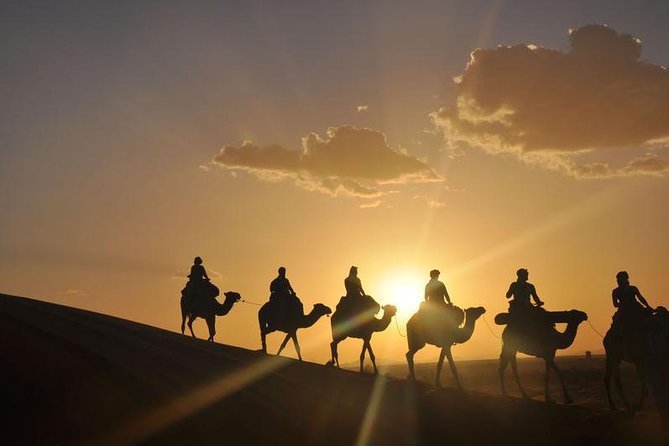
The conventional arrival is by camel in the late afternoon. Dromedaries are slower and steadier than most people expect, though anyone with back or hip problems should ask for a 4×4 transfer instead, which any reputable operator can arrange. Camps range from simple canvas with shared facilities to permanent structures with private bathrooms and proper beds. Dinner is usually tagine, and the evening generally involves drumming around a fire.
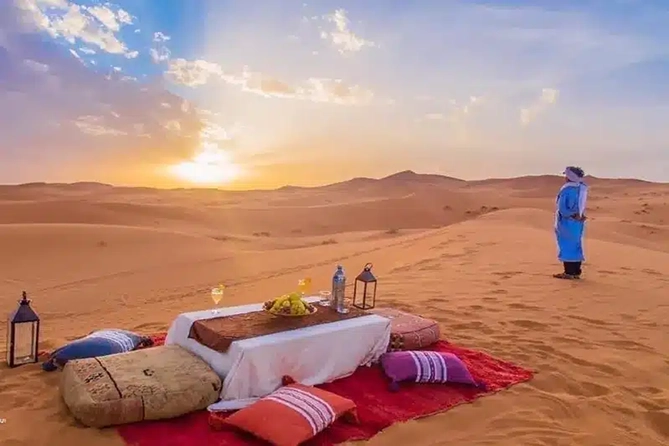
Sunrise is the part worth the alarm: climbing a dune behind camp in soft sand takes longer than it looks, and the light moving across the crests is what people come for. The area also supports sandboarding, quad excursions, and 4×4 runs to the black volcanic hills, the seasonal Dayet Srji lake where flamingos sometimes appear in spring, and the village of Khamlia, whose community descends from sub-Saharan populations and maintains a Gnawa musical tradition. What makes the Sahara land differently from everything before it is scale and silence: the gorges are dramatic but enclosed, while the erg is open in every direction.
Suggested 3-Day Marrakech to Merzouga Itinerary
This is the classic round trip and the most booked shape of the journey. Two nights, one in the Dades Valley and one in the desert.
Day 1
Marrakech to the Dades Valley
Driving: around 7 hours with stops. Early departure, the Tizi n’Tichka crossing with viewpoint stops, then Ait Ben Haddou late morning with time to walk into the ksar properly. Lunch in or near Ouarzazate, then east past Skoura and the Valley of Roses to an overnight in the Dades. Prioritise Ait Ben Haddou over everything else today.
Day 2
Dades to Todra Gorge and on to Merzouga
Driving: around 5 to 6 hours. Through the Valley of a Thousand Kasbahs to Todra Gorge, where an hour on foot is about right at this pace, then on via Tinghir and Erfoud, with Rissani if it is a market day, reaching the edge of the erg in the late afternoon for the camel trek and a night at a desert camp.
Day 3
Sunrise, then the return to Marrakech
Driving: around 9 to 10 hours with breaks. Sunrise over the dunes, breakfast at camp, then the long drive back, usually arriving in Marrakech in the early evening. This is the demanding day and the main trade-off of the three-day format.
Three days suits travellers with a fixed return flight from Marrakech and a week or less in the country. It suits young children, anyone who finds long car days difficult, and photographers rather less well. If it fits your dates, our 3 Days Desert Tour from Marrakech to Merzouga follows exactly this structure.
Ready to experience this route? See our 3-Day Marrakech to Merzouga Desert Tour.
Suggested 4-Day Marrakech to Merzouga Itinerary
The fourth day adds very little new geography. What it removes is compression: daily driving drops from seven to nine hours down to roughly three to five, and the stops that were pauses become visits.
Day 1
Marrakech to Ouarzazate
Driving: around 4 to 5 hours. The Atlas crossing at a relaxed pace, optionally with the Telouet detour, then an unhurried afternoon at Ait Ben Haddou in better light. Overnight in Ouarzazate or in the village itself.
Day 2
Ouarzazate and Skoura to the Dades Valley
Driving: around 3 hours. Kasbah Taourirt or the film studios in the morning, then east to Skoura for a walk in the palmeraie and a visit to Amridil, through the M’Goun valley, arriving in the Dades with daylight left to see the gorge.
Day 3
Dades to Todra Gorge and Merzouga
Driving: around 5 hours. A longer walk at Todra beyond the narrow section, the Tinghir oasis viewpoint, then Erfoud and Rissani before arriving at Erg Chebbi for the camel trek and the desert camp.
Day 4
Sahara morning, then the return
Driving: variable. Sunrise, then a full morning in the desert for sandboarding, a 4×4 run to Khamlia and the black desert, or simply a slow breakfast, before the return. Some four-day versions break that return with a night in Ouarzazate.
The exact shape varies between operators and can be adjusted, which is rather the point of the extra day. Our 4-Day Tour from Marrakech to Merzouga is built around this redistribution of time rather than around adding stops.
Is 3 Days or 4 Days Better from Marrakech to Merzouga?
| Factor | 3 Days | 4 Days |
|---|---|---|
| Pace | Fast | More relaxed |
| Driving distribution | Concentrated, one very long day | Spread evenly across four |
| Sightseeing | Essential highlights | More flexibility |
| Ait Ben Haddou | Yes, around 90 minutes | Yes, unhurried and in better light |
| Skoura | Usually passed | Realistic stop |
| Dades Valley | Yes, overnight | Yes, with time to see the gorge |
| Todra Gorge | Yes, short walk | Yes, longer walk |
| Sahara | One night, early departure | One night plus a full morning |
| Best for | Limited time | Comfortable exploration |
Neither is universally better. Three days is the right answer when your dates are fixed and the alternative is not going at all. Four days suits families with children, travellers who dislike long drives, photographers, and anyone returning to Morocco who already knows the highlights. The genuinely poor choice is compressing Merzouga into two days.
Other Ways to Travel from Marrakech to Merzouga
Private or small-group tour
The most common approach, and the one that removes the most friction: door-to-door from your riad, a driver who knows the road, flexible timing on the day, and the camp, camel trek and overnights already arranged. The practical advantage is that nobody in your group spends eighteen hours driving mountain roads. The trade-off is cost and slightly less spontaneity than a car of your own. For the formats and durations available, our Morocco tours from Marrakech page sets out options from two days onward.
Rental car
A rental car is feasible and a good choice for confident drivers who want their own schedule. The roads are paved the whole way and generally in reasonable condition. What people underestimate is the Tichka: two hours of continuous bends shared with freight, occasionally with roadworks, and demanding in poor weather. Rural roads bring livestock, pedestrians, and unlit vehicles after dark, so plan to arrive before sunset each day. At the end you park at the edge of the sand, and your camp arranges the transfer. Fuel stations are frequent on the main route but thin out on side roads.
Public transport
Possible, cheap, and slow. Supratours and CTM run buses from Marrakech southeast to Rissani and, on some schedules, Merzouga itself, typically taking eleven to thirteen hours. There is no train south of Marrakech. The real constraint is not the bus but the route: public transport takes you to the destination and past everything worth stopping for, and you will still need a transfer from the village into the dunes. Travellers doing it this way usually base themselves in Merzouga for two or three nights and book activities locally, which is a reasonable trip in its own right, just a different one.
Which suits which traveller? Independent travellers with time and driving confidence do well with a rental car. Travellers on a tight schedule, families, and anyone who wants the route explained as they go generally get more from a guided trip. Budget travelers with flexible dates can make the bus work, provided they accept that the journey becomes transport rather than sightseeing.
Is Marrakech to Merzouga Worth It?
For most travellers, yes, with one condition: the itinerary has to let you actually stop. The value of this route is the variety compressed into it—mountains, kasbahs, oases, canyons and a dune sea inside about 560 kilometers—and that variety only registers if you get out of the vehicle. Ait Ben Haddou seen in forty minutes is a photograph. Todra seen from the road is a wall of rock.
It suits some travellers less well. Anyone with four or five days total in Morocco who also wants Fes, Chefchaouen or the coast will spend most of the trip in a car, and anyone who genuinely dislikes long drives will find three days hard work. If what you want is specifically dunes with minimal travel, the Zagora route reaches a smaller erg in two days. A useful test: if the parts of the journey between the dunes sound appealing, this is a very good trip. If they sound like the price of admission, consider a shorter option.
Best Time to Travel from Marrakech to Merzouga
The route crosses three climates in two days, so no single month is ideal for everything at once.
| Season | Mountains | Desert | Notes |
|---|---|---|---|
| Spring (Mar to May) | Mild, occasional snow early on | Warm days, cool nights | Busiest period. Roses bloom late April to May. Book ahead. |
| Summer (Jun to Aug) | Pleasant at altitude | Frequently above 40C | Manageable with dawn starts and activities at either end of the day. |
| Autumn (Sep to Nov) | Clear and stable | Warm, comfortable nights | Arguably the best all-round balance. Date harvest in October. |
| Winter (Dec to Feb) | Cold, snow possible on the pass | Mild days, near freezing at night | Quietest and often the clearest light. Bring real winter layers. |
Spring and autumn are the most comfortable seasons, which is why they are also the busiest and most expensive. Winter is genuinely rewarding if you accept cold desert nights, and the Atlas under snow is a considerable sight. Summer is the only season with a real caveat, but early starts can help you avoid most of it. The right window depends on whether your priority is comfort, cost, or quiet.
What to Pack for the Marrakech to Merzouga Journey
Layers do most of the work here. In one day you can be in a warm city, on a mountain pass considerably cooler, and in a desert that loses much of its heat within an hour of sunset. Packing for only one of those three is the most common mistake.
- Comfortable closed walking shoes
- Layers you can add and remove
- Fleece or light jacket, year-round
- Warm jacket in winter
- Sun hat and high-SPF sunscreen
- Sunglasses
- Scarf or buff for wind and sand
- Refillable water bottle
- Camera or phone, plus a power bank
- Small overnight bag for the desert camp
- Cash in dirhams for small purchases
- Any personal medication and basic toiletries
Two notes on the overnight bag: camps are reached on foot or by camel, so take a small bag for one night and leave the rest in the vehicle or at your riad, and electricity at most camps is solar and limited, so charge everything during the day.
Practical Tips for the Route
Start early and keep some slack. Departures between 7 and 8am are standard because the first day is the longest, and roadworks on the Tichka are routine. A schedule with no margin becomes a series of missed stops.
Take the mountain roads seriously. Two hours of continuous bends affects passengers as well as drivers. If anyone is prone to motion sickness, put them in the front, keep a window open and say so before departure rather than halfway up.
Carry cash and water. ATMs are reliable in Marrakech, Ouarzazate and Erfoud, and absent in villages. Lunches, entry fees and tips are usually cash, with dirhams better received than euros away from tourist sites. Dry air at altitude and in the desert also dehydrates faster than the temperature suggests. Fuel stations along the N9 and N10 are frequent enough and usually have a toilet and a cafe, though standards vary.
Be a decent guest. Ask before photographing people, particularly at Rissani market and in villages. Buy directly from cooperatives where you can, keep water use in mind at a camp where it is trucked in, take rubbish back out of the dunes, and follow local guidance in rural areas about where it is appropriate to walk or drive.
Marrakech to Merzouga Route Map
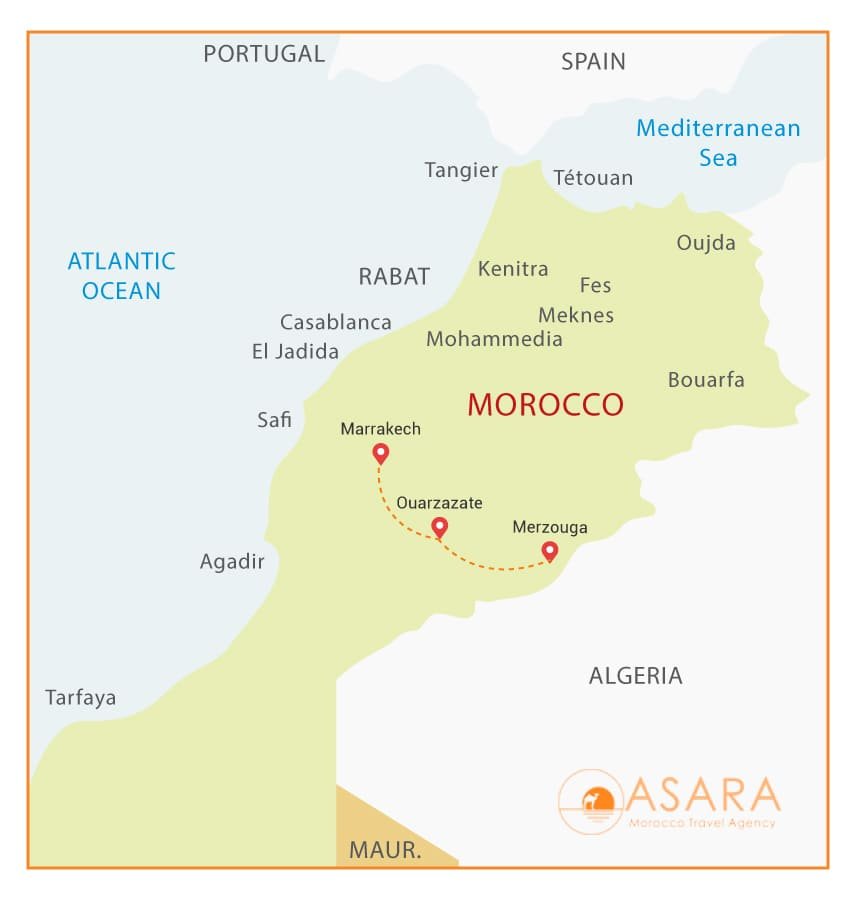
The route runs south out of Marrakech, crosses the High Atlas, then turns east and follows the valleys along the northern edge of the Sahara before dropping to the dunes. Every stop below sits on that line, which is why the sequence rarely changes between operators.
Marrakech → Tizi n’Tichka → Ait Ben Haddou → Ouarzazate → Skoura → Dades → Todra Gorge → Erfoud → Rissani → Merzouga
Frequently Asked Questions
How far is Marrakech from Merzouga?
Roughly 550 to 570 kilometres by road. Different sources quote slightly different figures because the exact distance depends on which detours the route takes and where in Merzouga you are measuring. Straight-line distance is only around 350 km, which is why the drive is longer than a map suggests.
How long does it take to drive from Marrakech to Merzouga?
In good conditions, it takes about eight to nine hours of continuous driving. In practice, most people do not finish it in one go. Standard itineraries split the drive across two days with an overnight in the Dades Valley, which turns the same distance into a manageable journey with time for stops.
What is the best route from Marrakech to Merzouga?
South over the Tizi n’Tichka pass to Ait Ben Haddou and Ouarzazate, then east through Skoura, Kelaat M’Gouna, Boumalne Dades, Tinghir and Todra Gorge, then on to Erfoud, Rissani and Merzouga. It is paved throughout and is the route that almost all operators use. The southern alternative via Zagora and the Draa Valley is sometimes used on the return.
What are the best stops between Marrakech and Merzouga?
Ait Ben Haddou, Ouarzazate, Skoura, the Dades Valley, Todra Gorge and Rissani are the strongest, with Erg Chebbi as the destination. In three days, you can visit four or five of them. On four days Skoura becomes realistic and Todra and Ait Ben Haddou get proper time.
Can you travel from Marrakech to Merzouga in 3 days?
Yes, and three days is the standard minimum for a round trip. It covers the Atlas crossing, Ait Ben Haddou, the Dades Valley, Todra Gorge, a camel trek and a night at a desert camp. Expect a long final day of nine to ten hours returning to Marrakech.
Is four days enough for the trip from Marrakech to Merzouga?
Four days is comfortable rather than merely enough. Daily driving falls to roughly three to five hours, you gain a stop at Skoura, more time at Todra and Ait Ben Haddou, and a full morning in the dunes instead of an early departure.
Can you drive from Marrakech to Merzouga yourself?
Yes. The route is paved the whole way and rental cars are widely available in Marrakech. The main considerations are the Tizi n’Tichka, which is two hours of continuous bends shared with freight traffic, and rural roads after dark. Plan to arrive at each overnight before sunset, and expect to park at the edge of the sand rather than driving into the dunes.
Is there a bus or train from Marrakech to Merzouga?
There is no train south of Marrakech. Supratours and CTM run long-distance buses towards the southeast, reaching Rissani and on some schedules Merzouga, typically taking eleven to thirteen hours. It is cheap and workable, but it takes you past every stop worth making, and you will still need a transfer from the village into the dunes.
Is Marrakech to Merzouga worth the journey?
For most travellers yes, provided the itinerary allows time to stop. The appeal is the range of landscapes in a single route: mountains, kasbahs, oases, canyons and a dune sea. Travellers with only a few days in Morocco, or who dislike long drives, may prefer the shorter Zagora route or a different region altogether.
What is the best time to travel from Marrakech to Merzouga?
March to May and September to November offer the most comfortable conditions and are also the busiest. Winter is quiet with excellent light, cold nights in the desert and possible snow on the pass. Summer regularly exceeds 40C in the south but works with early starts and activities kept to sunrise and sunset.
What is the difference between Merzouga and Erg Chebbi?
Merzouga is the village on the western edge of the sand, where the road, hotels and shops are. Erg Chebbi is the dune field itself, around 25 to 30 km long with dunes over a hundred metres high. A hotel in Merzouga looks at the dunes. A camp in Erg Chebbi is inside them, reached by camel, on foot or by 4×4.
Working out which version of this route fits your dates?
Send us your travel dates, group size and how many days you can spare. Our team in Marrakech will come back with a realistic plan, usually within a couple of hours.
Tours That Follow This Route
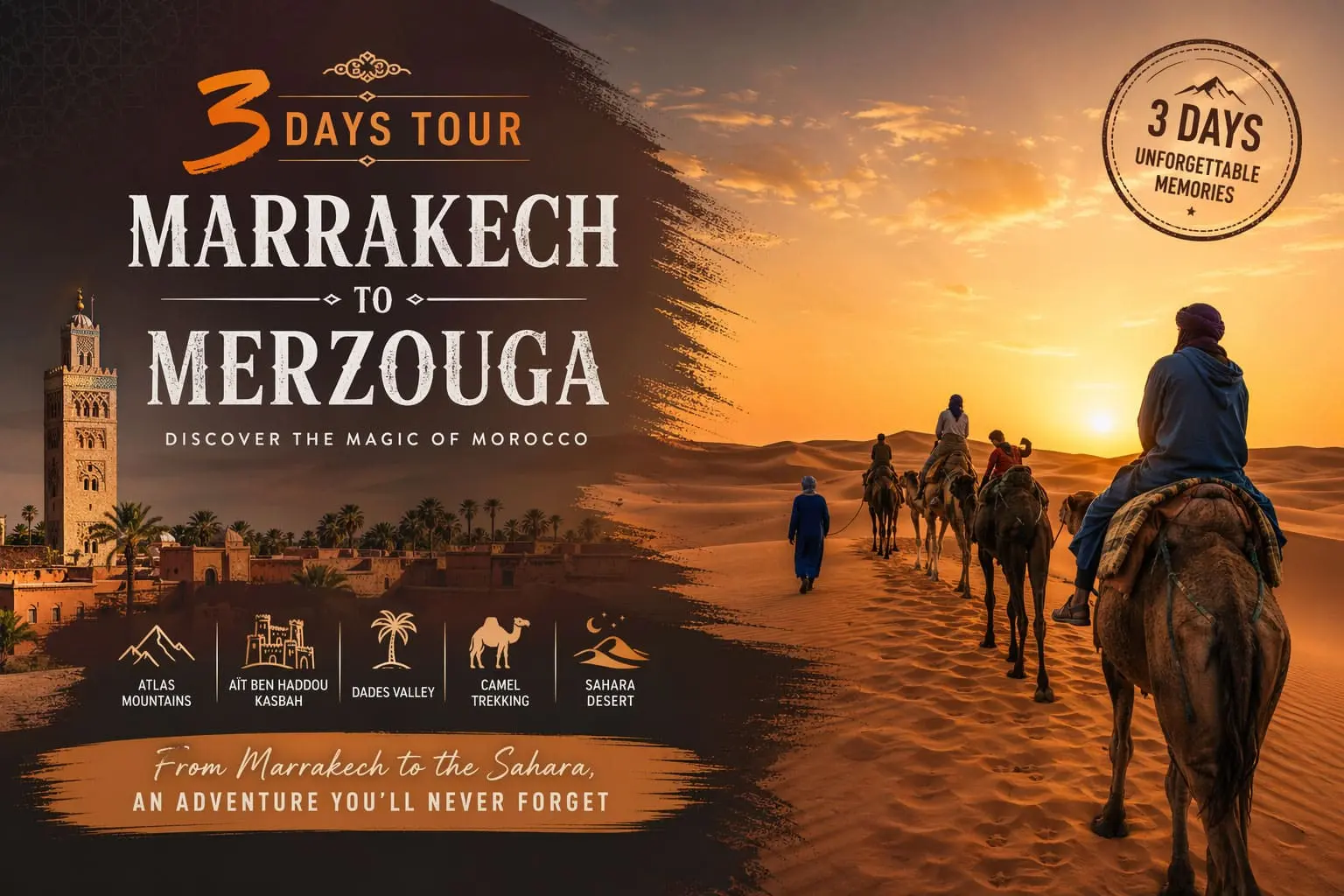
3 Days Marrakech to Merzouga
The classic round trip. Atlas, Ait Ben Haddou, Dades, Todra, a night in a camp inside Erg Chebbi and back to Marrakech.
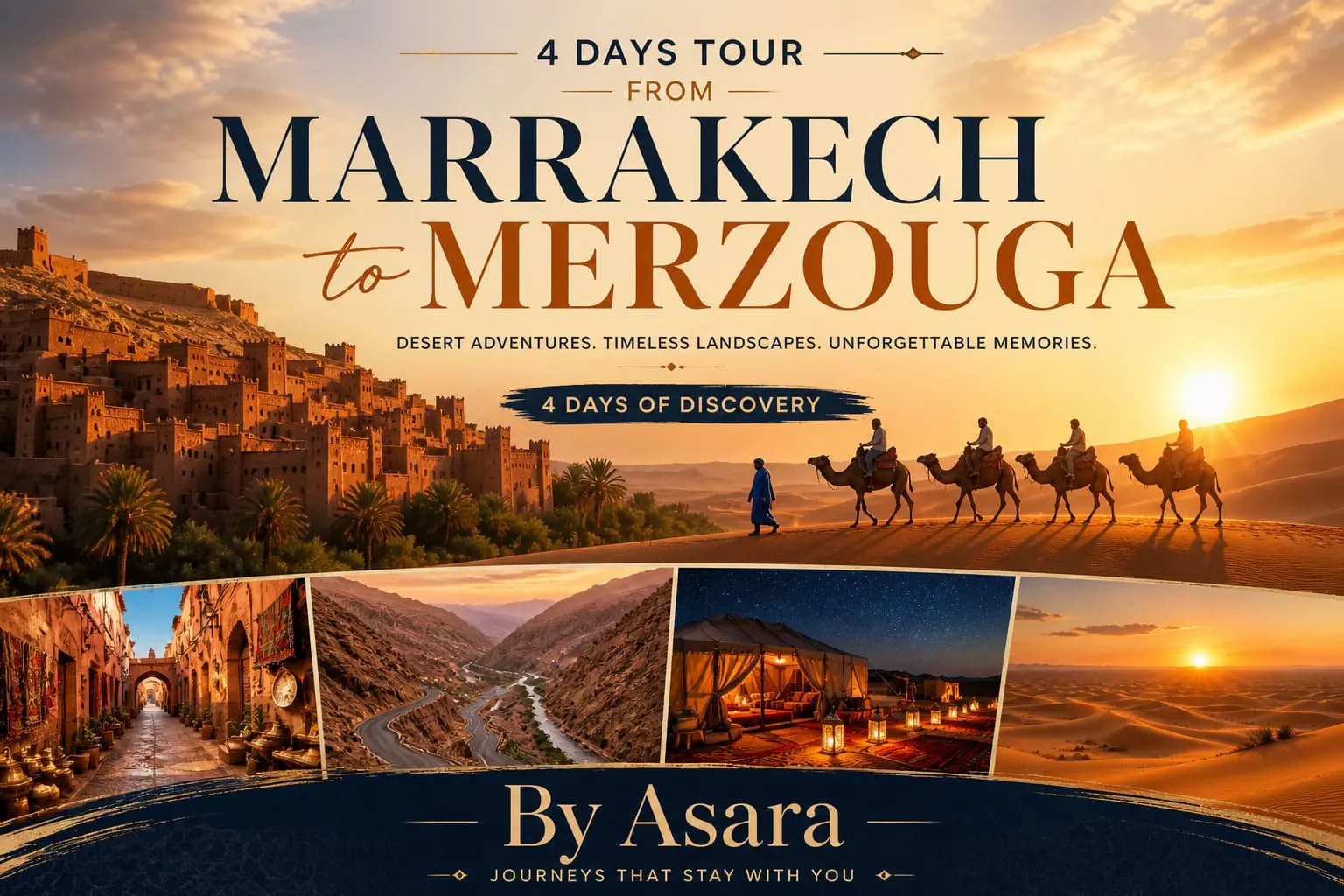
4 Days Marrakech to Merzouga
Half the daily driving, with time for Skoura, a longer walk at Todra and a full morning in the dunes.