
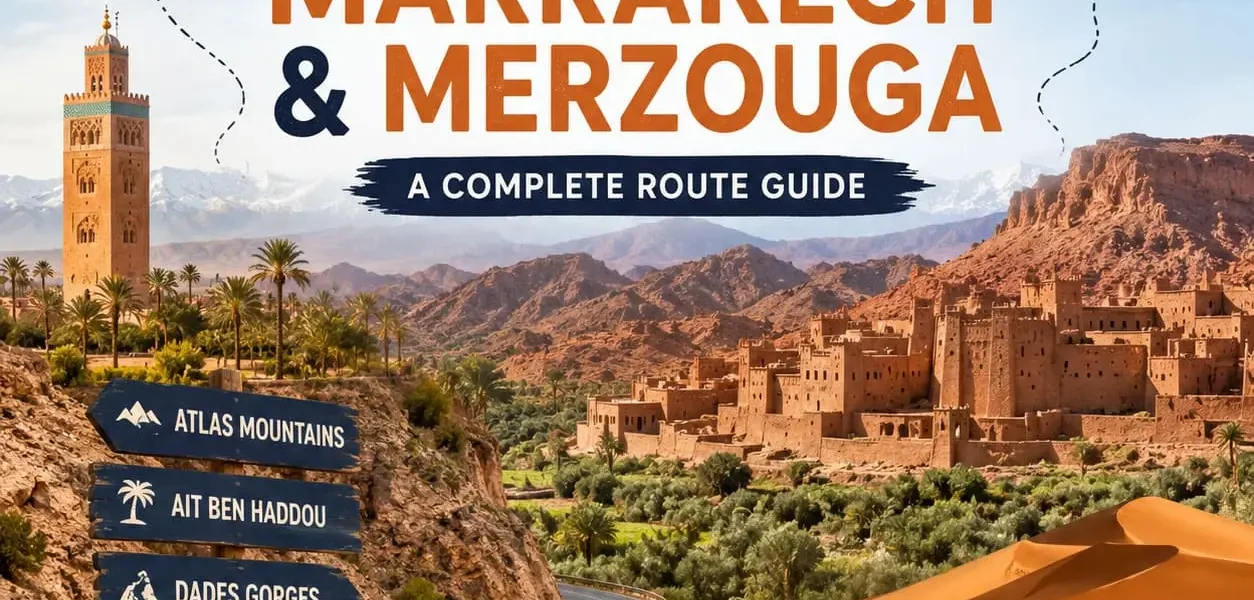
Morocco Destination Guide ✦ 2026
Best Stops Between Marrakech and Merzouga: A Complete Route Guide
The road from Marrakech to Merzouga is one of those journeys where the driving is not the price you pay for the destination. It is part of the destination. In a single day you climb from a palm-fringed city at 450 metres to a mountain pass above 2,200 metres, drop into a stony pre-Saharan plateau the colour of terracotta, and finish the following afternoon at the edge of a dune sea. Very few countries change their scenery that quickly.
The geographical sequence is worth fixing in your head before you plan anything, because it explains why certain itineraries work and others do not: Marrakech, then the High Atlas over the Tizi n’Tichka pass, then Ait Ben Haddou, Ouarzazate, Skoura, the Valley of Roses, Dades Valley, Todra Gorge, Tinghir, Erfoud, Rissani, and finally Merzouga on the western edge of Erg Chebbi. Almost every operator, ours included, follows some version of this line, because it is the only sensible way through the mountains and the valleys beyond them.
What varies is how many of those places you actually stop at, and for how long. That is really the whole question. A driver can cover the distance in a day. A traveller who does that arrives at the dunes having seen a great deal through a window and very little on foot.
The best stops between Marrakech and Merzouga include Tizi n’Tichka Pass, Ait Ben Haddou, Ouarzazate, Skoura, the Valley of Roses, Dades Valley, Todra Gorge, Erfoud, Rissani and the Erg Chebbi dunes at Merzouga.
Marrakech to Merzouga at a Glance
Before looking at individual stops, it helps to see the shape of the journey. The figures below are working approximations rather than fixed numbers, and the driving time in particular moves around a great deal depending on roadworks on the Tichka, weather in the mountains, how many people are in your vehicle, and how often you get out of it.
| Detail | What to expect |
|---|---|
| Approximate distance | Around 550 to 570 km one way, depending on the exact route and detours |
| Driving time without sightseeing | Roughly 8 to 9 hours of pure driving, spread over mountain and desert roads |
| Recommended days | 3 days minimum for a round trip, 4 days for a comfortable pace |
| Main landscapes | High Atlas peaks, pre-Saharan plateau, palm oases, red gorges, sand dunes |
| Major attractions | Tizi n’Tichka, Ait Ben Haddou, Ouarzazate, Skoura, Dades, Todra, Rissani, Erg Chebbi |
| Best travel style | Private or small-group vehicle with a driver who knows the road |
| Best months | March to May and September to November for the most comfortable conditions |
Any single number for this journey is misleading. Snow can close or slow the Tizi n’Tichka in winter, roadworks are common on the mountain section, and a group that stops for photographs every twenty minutes will take two hours longer than one that does not. Treat published timings as a guide and build in a margin, particularly on the first day.
The Best Stops Between Marrakech and Merzouga
These are listed in the order you meet them driving south and east. Not every traveller should stop at all of them on one trip, and part of planning well is deciding which three or four deserve real time rather than a photograph from the car park.
1. Tizi n’Tichka Pass and the High Atlas Mountains
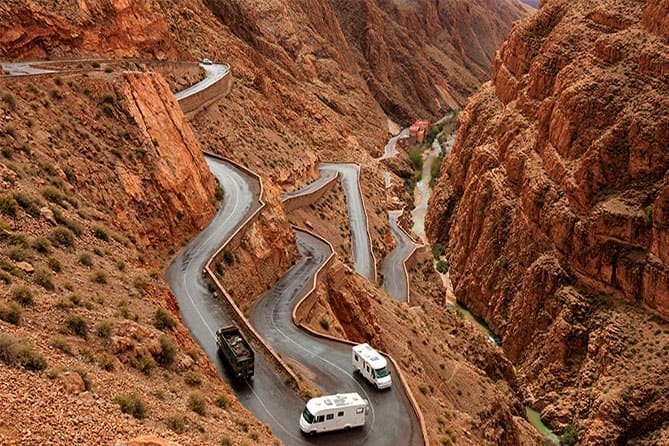
The Tizi n’Tichka is the highest paved pass in Morocco, crossing the High Atlas at roughly 2,260 metres. It is also the first thing that tells you the south is going to look nothing like Marrakech. The road leaves the Haouz plain, climbs through walnut and almond terraces, and then spends an hour switching back across bare rock and scree. Villages appear on impossible slopes, built from the same earth they stand on, and the vegetation thins as you gain altitude.
Most of the value here comes from stopping properly. There are established viewpoints and cafe terraces near the summit and on the descent, with parking and space to walk a few metres from the vehicle. These are the places to use. Stopping on the verge of a mountain road with blind bends and heavy lorry traffic is genuinely dangerous, and a driver who knows the route will already have two or three safe pull-ins in mind.
A short detour just after the pass leads to Telouet, where the half-ruined Glaoui kasbah still holds carved cedar ceilings and painted plasterwork behind a very plain exterior. It adds perhaps ninety minutes to the day and it is one of the more rewarding uses of that time on the whole route, though it is more commonly included on slower itineraries than on a tight three-day schedule.
The Tichka has hundreds of bends over about two hours. Sitting in the front, keeping a window slightly open and looking at the horizon rather than a phone all help. Say so before departure rather than halfway up, so your driver can plan short breaks.
2. Ait Ben Haddou
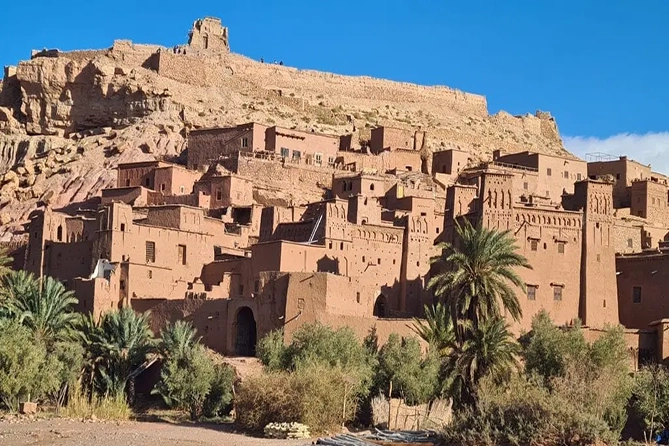
A ksar is a fortified village, and Ait Ben Haddou is the best preserved example most travellers will ever see. Earthen towers rise in tiers above a shallow riverbed, packed close together behind a defensive wall, with a granary at the summit that once protected the community’s stores. The building material is pisé, rammed earth mixed with straw, which is why the whole village glows the colour of the hillside behind it and why it needs constant repair. It was inscribed on the UNESCO World Heritage list in 1987.
The mistake is to treat it as a photograph. A great many visitors park, walk to the far bank, take the classic shot of the ksar from the river, and leave within half an hour. What they miss is the inside: narrow earth lanes, doorways with geometric carving, workshops, and the climb to the old granary, which takes maybe twenty-five minutes at a relaxed pace and gives you the whole Ounila valley in one sweep.
It has an obvious cinematic reputation, and guides will happily point out where various productions filmed. That is a pleasant footnote rather than the reason to come. The reason to come is that it is a working example of a defensive architecture that once ran the length of these valleys and now survives in very few places intact.
Late afternoon is considerably better than midday. The light is warmer, the earth walls take on colour, and the day-trip coaches from Marrakech have usually gone. Travellers on slower itineraries sometimes stay overnight in the village specifically for this.
3. Ouarzazate
Ouarzazate is often called the gateway to the south, and the label is geographical rather than promotional. Roads converge here from the Draa Valley, the Dades, the Atlas and the Anti-Atlas, which is why it grew from a garrison post into the administrative centre of the region. If you are heading to Merzouga you will pass through it, and on most three-day itineraries that means lunch and a stretch of the legs.
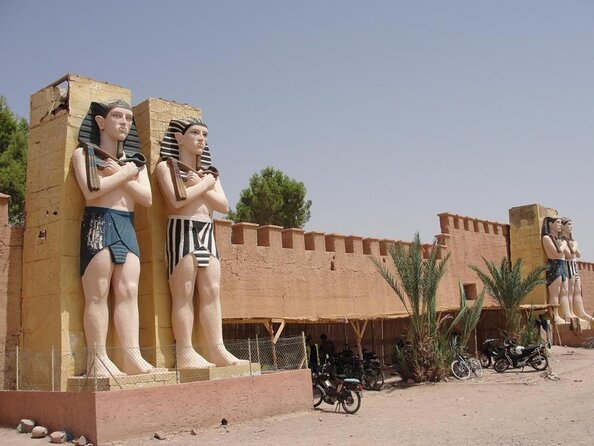
The Taourirt Kasbah, on the eastern edge of the centre, is the main historic site: another Glaoui property, a warren of staircases, painted ceilings and roof terraces, partly restored and considerably quieter than Ait Ben Haddou. Atlas Film Studios sits just outside town, with standing sets left in the open desert. Whether that appeals depends entirely on your interests, and it is fair to say some visitors find it more entertaining than others.
Some travellers stay overnight here, usually on longer itineraries or on the return leg, because it has the widest choice of hotels between Marrakech and the desert. Others pass through in under an hour. Both are reasonable. It is a useful, functional town with two or three genuinely good sights rather than a destination in its own right.
4. Skoura and the Palm Oasis
Half an hour east of Ouarzazate the ground turns green without warning. Skoura is a large palmeraie, a cultivated oasis where date palms shade olive trees, almonds, figs and small irrigated plots, all fed by channels that have been maintained by hand for centuries. Scattered among them are kasbahs in various states of repair, the best known being Amridil, which is old enough and complete enough to give a clear picture of how these fortified family houses were organised.
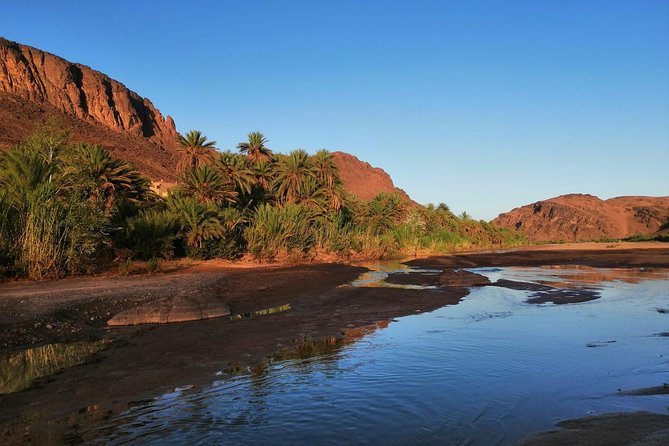
The contrast is what makes it worth the detour. You have spent the last hour on a dry, open plateau and suddenly you are walking under dense shade on soft ground with water running beside the path. Skoura is also one of the better places on this route for travellers who want something slower and less visited. A few of the kasbahs operate as guesthouses, and staying in one changes the character of the trip considerably. On a three-day schedule Skoura is usually a brief roadside impression at best, which is a fair reason to consider the longer version.
5. The Valley of Roses
Between Skoura and Boumalne Dades the road runs through the M’Goun valley, generally known as the Valley of Roses, centred on the town of Kelaat M’Gouna. Damask roses are grown here in hedgerows along the irrigation channels and field boundaries rather than in ornamental beds, and the harvest supports a local industry producing rose water, distilled oil and cosmetics.
Be clear about the seasonality, because this is where a lot of travel writing quietly misleads people. The blooming period is short, typically falling around late April into May depending on the year and the weather, and it is marked by a rose festival in Kelaat M’Gouna. Outside that window you will see the valley, the mountains behind it and the shops selling rose products, but you will not see fields of flowers. That is not a reason to skip it. It is a reason to adjust expectations.
Late April to May: hedgerows in bloom, harvest under way in the early morning, festival period.
June to October: green valley floor, distillation and shops active, no flowers.
November to March: bare hedges, sharp mountain light, very quiet, still a pleasant drive.
6. Dades Valley and the Dades Gorge
Boumalne Dades sits at the mouth of a valley that cuts north into the High Atlas, and the drive up it is one of the most distinctive stretches in southern Morocco. The lower section is agricultural: a green ribbon of fields and poplars with kasbahs on the slopes above. Higher up, the rock takes over. There is a section of extraordinary weathered sandstone formations, rounded and bulbous, which local people describe as monkey fingers, and further on the road performs a series of tight hairpins climbing the gorge wall that appear in more or less every photograph of the region.
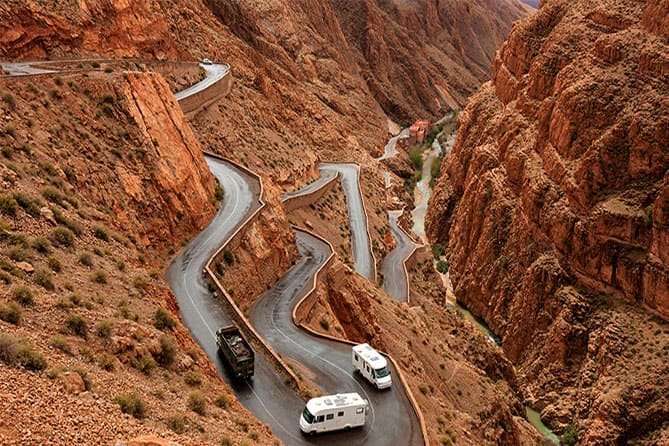
Amazigh villages line the valley, and the guesthouses and kasbah hotels along it are a large part of why almost every Marrakech to Merzouga itinerary overnights here. It breaks the drive at a sensible point, roughly two thirds of the way, and it means you wake up inside the scenery rather than driving into it. Evenings are cool at this altitude even in summer, which after a long day in the car is not a small thing.
Travellers with more time can walk a section of the valley floor in the morning before continuing east. Those on a tight schedule generally arrive in the late afternoon and leave after breakfast, which is enough to see the gorge properly but not enough to explore beyond it.
7. Todra Gorge
Todra is the second of the two great canyons on this route, reached through the town of Tinghir and its long palm oasis. Where Dades is broad and winding, Todra is narrow and vertical. At its tightest point the limestone walls close to a corridor a few tens of metres wide, rising several hundred metres on either side, with a shallow stream and a road running along the bottom. The change in temperature as you walk into the shade is immediate.
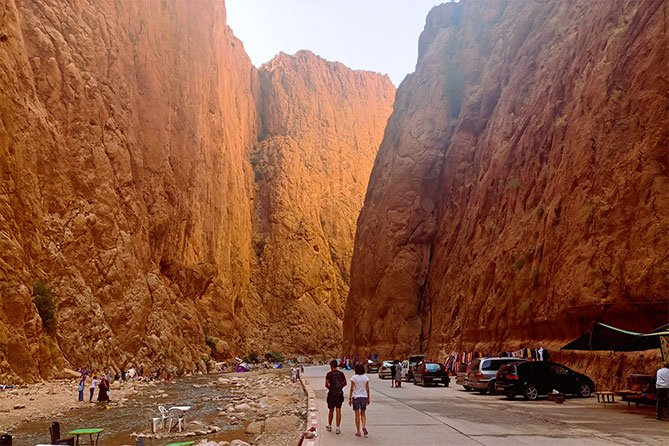
Most visitors walk the flat section between the cliffs, which takes half an hour at an easy pace and requires nothing more than ordinary shoes. Beyond that there are longer valley walks and marked trails, and Todra is a well established rock climbing destination with routes bolted on both walls. If you have any interest in walking, this is the stop on the route where an extra hour pays off most obviously.
The oasis at Tinghir on the approach is worth a look in its own right. Seen from the road above, it is a long green strip of date palms and small fields running between bare hills, with the old ksour built up the slope on either side.
8. Erfoud
Erfoud is the last town of any size before Merzouga, and it functions largely as a supply point for the Tafilalt oases and the desert beyond. Two things make it interesting for a short stop. The first is geology: the surrounding hills are rich in marine fossils from a period when this part of North Africa lay under a shallow sea, and orthoceras and goniatite fossils are cut and polished locally into tabletops, basins and small objects. Several workshops will show you the sawing and polishing process, which takes twenty minutes and is more interesting than it sounds.
The second is dates. The Tafilalt is one of Morocco’s major date-producing regions, and the annual harvest in October is a significant local event. Outside that season the markets still sell a wide range of varieties, and it is a reasonable place to buy some.
Erfoud rarely justifies an overnight when Merzouga is under an hour further on, and the dunes are unquestionably the better place to sleep. Treat it as a break in the drive rather than a destination.
9. Rissani
Rissani carries more history than its present size suggests. It stands close to the site of Sijilmassa, a medieval caravan city that was for centuries a northern terminus of trans-Saharan trade routes, and the town remains associated with the origins of the Alaouite dynasty that rules Morocco today. The mausoleum of Moulay Ali Cherif is here.
The souk is the reason most travellers stop. It operates on set days, traditionally Sunday, Tuesday and Thursday, and it is a working regional market rather than a tourist one: livestock, dates by the sack, agricultural tools, hardware, textiles. Prices and conversations reflect that. Visitors are welcome but nobody is performing for them, and photographing people without asking is as unwelcome here as it would be anywhere else.
Rissani is where you find medfouna, a stuffed flatbread baked in a wood oven, often described to visitors as Berber pizza. It is filled with spiced meat, onion and almonds and is genuinely local rather than invented for tourists. Ordering one takes a while because it is baked to order.
10. Merzouga and the Erg Chebbi Dunes
Everything before this point has been a variation on rock, valley and oasis. Erg Chebbi is something else entirely. It is a sand sea roughly 25 to 30 kilometres long and several kilometres wide, with the tallest dunes rising well over a hundred metres, and it begins abruptly: flat hammada, then sand. Merzouga is the village on its western edge, and it exists largely because of the erg.
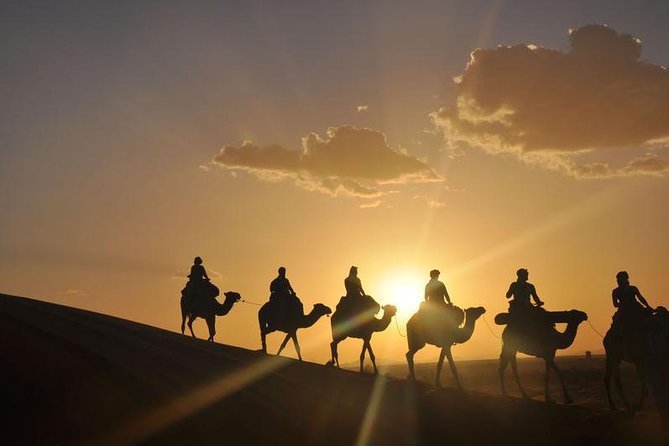
The conventional arrival is by camel in the late afternoon, an hour or so at walking pace from the edge of the sand to a camp set between dunes. Dromedaries are slower and more comfortable than most people expect, though anyone with back or hip problems should ask about a 4×4 transfer instead, which every reputable operator can arrange. Camps range from simple canvas tents with shared facilities to permanent structures with private bathrooms and proper beds. Dinner is usually tagine, and the evening tends to involve drumming around a fire.
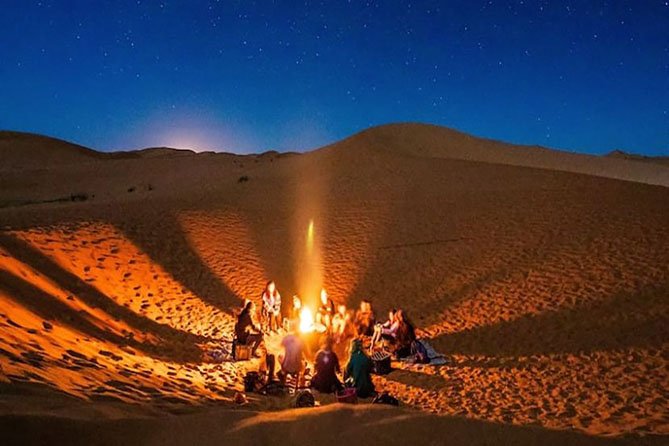
Sunrise is the moment worth setting an alarm for. Climbing a dune behind camp in the half hour before dawn is hard work in soft sand and takes longer than it looks, but the light moving across the crests is the reason people come. Beyond that, the area supports sandboarding, quad excursions and 4×4 trips out to the black volcanic hills, the seasonal Dayet Srji lake where flamingos sometimes appear in spring, and the village of Khamlia, whose community descends from sub-Saharan populations and maintains a Gnawa musical tradition. A visit there is a straightforward, unstaged cultural stop when it is arranged respectfully.
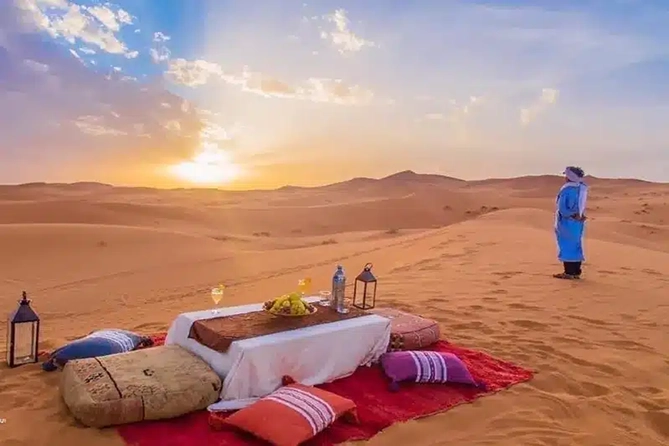
Calling Merzouga a stop undersells it. Everything else on this route is something you look at. The desert is somewhere you spend a night, and the difference between the two is what the whole journey is for.
Best Stops for a 3-Day Marrakech to Merzouga Tour
Three days is the shortest realistic window for a Merzouga round trip from Marrakech. It works, a great many people do it, and it delivers the genuine article: the Atlas, the ksar, a gorge, a night in the dunes and a sunrise. It also involves two long driving days, and being honest about that in advance prevents disappointment.
Marrakech to the Dades Valley
An early start, the mountain crossing with viewpoint stops, then Ait Ben Haddou in the late morning or early afternoon with enough time to walk into the ksar rather than admire it from the far bank. Lunch in or near Ouarzazate, a quick look at the Taourirt Kasbah if the schedule allows, then east past Skoura and the Valley of Roses to an overnight in the Dades Valley. Long day, roughly seven hours of driving broken by stops.
Dades to Todra Gorge, then Merzouga
A morning through the Valley of a Thousand Kasbahs to Todra Gorge, where an hour on foot between the cliffs is about right at this pace. On to Tinghir, Erfoud and the edge of the erg, arriving in the late afternoon for the camel trek and a night at a camp in the dunes.
Sunrise, then the long road back
Sunrise over the dunes, breakfast at camp, and often a stop at Rissani before the return. This is the demanding day: roughly nine to ten hours back to Marrakech with breaks, usually arriving in the early evening.
Travellers with a fixed return flight from Marrakech and a week or less in Morocco, people happy to trade some depth for reach, and anyone who would rather see the Sahara briefly than not at all. It is not the right choice for young children, for anyone who finds long car days genuinely difficult, or for photographers who need to be somewhere specific at a specific hour.
If that shape fits your trip, our 3 Days Desert Tour from Marrakech to Merzouga follows this route with the overnights in the Dades Valley and at a camp inside Erg Chebbi.
Best Stops for a 4-Day Marrakech to Merzouga Tour
The fourth day does not add a great deal of new geography. What it does is remove the compression. Daily driving drops from seven to nine hours down to roughly three to five, and the stops that were fifteen-minute pauses become proper visits.
In practice the extra time lands in four places. Ait Ben Haddou gets an unhurried afternoon rather than a slot between drives, ideally in the better light. Skoura becomes reachable as an actual stop, with a walk in the palmeraie and a visit to Amridil, rather than a green blur from the road. Todra Gorge gains a longer walk beyond the narrow section. And Merzouga gets a full morning instead of a departure, which is where sandboarding, a 4×4 run out to Khamlia and the black desert, or simply a slow breakfast in the dunes become possible. Many four-day itineraries also break the return with a night in Ouarzazate rather than driving the whole way back in one push.
The practical benefits compound. Fewer hours in the car means more willingness to get out of it. Golden hour becomes something you can plan around rather than something you watch through a window. Short walks stop feeling like a delay. And there is enough slack in the schedule to change plans on the day, which on a route this long is worth more than any individual stop.
Families with children, travellers over sixty, anyone prone to motion sickness, photographers, and people returning to Morocco for a second time who already know the highlights and want to slow down.
Our 4-Day Tour from Marrakech to Merzouga is built around exactly that redistribution of time, with three overnights instead of two.
3 Days or 4 Days: Which Marrakech to Merzouga Route Is Better?
| Feature | 3 Days | 4 Days |
|---|---|---|
| Travel pace | Faster | More relaxed |
| Driving per day | Around 7 to 9 hours | Around 3 to 5 hours |
| Time for sightseeing | Limited | More flexible |
| Ait Ben Haddou | Yes, briefly | Yes, unhurried |
| Dades Valley | Yes | Yes |
| Todra Gorge | Yes | Yes, with a longer walk |
| Skoura palm oasis | Usually passed | Realistic stop |
| Sahara experience | Yes, one night | Yes, with a full morning |
| Photography stops | Fewer | More |
| Best for | Limited time | Travellers who prefer a slower journey |
There is no universally better option, and any operator who tells you otherwise is selling rather than advising. Three days is the right answer when your dates are fixed and the alternative is not going. Four days is the right answer when you have the flexibility, because the route rewards time more than almost any other in Morocco. The genuinely poor choice is squeezing Merzouga into two days, which means either an unreasonable amount of driving or reaching the smaller dunes near Zagora while believing you have seen Erg Chebbi.
What Is the Most Scenic Part of the Marrakech to Merzouga Route?
This question comes up constantly and it does not have an honest single answer, because the route offers half a dozen kinds of beauty that are not really comparable. What people usually mean is: which section will I like most? That depends on what moves you.
- Mountains: the Tizi n’Tichka, particularly in winter with snow on the peaks above the pass.
- Architecture: Ait Ben Haddou, especially in the last two hours of daylight.
- Oasis landscapes: Skoura, and the long palmeraie below Tinghir.
- Rock formations: the upper Dades Valley, where the weathered sandstone and the switchbacks are.
- Canyon scenery: Todra Gorge, at its narrowest point.
- Desert: Erg Chebbi at either end of the day.
Ask ten returning travellers and the answers split roughly along these lines, with the dunes taking a plurality rather than a majority. What is more consistent is the effect of the sequence. The desert lands harder because you have spent two days watching the landscape dry out on the way to it.
How Long Should You Spend Between Marrakech and Merzouga?
The minimum for a round trip is three days and two nights, with one of those nights in the desert. Anything shorter either skips the desert night, which removes the point, or reaches a different and much smaller dune field.
Four days is the comfortable version, and five turns it into something more like a proper exploration of the south, with room for the Draa Valley, a second desert night, or a slower run through the Dades and Todra valleys. One-way itineraries that finish in Fes rather than returning to Marrakech are also worth considering if your flights allow, because they eliminate a full day of retracing the same road.
Rushing this route has a specific cost, and it is not simply that you see less. It is that the stops stop being experiences. Ait Ben Haddou visited in forty minutes is a photograph. Todra seen from the car is a wall of rock. The gap between a good trip and a mediocre one here is measured in whether you got out and walked.
The other advantage of a private or custom itinerary is that the schedule can bend on the day. If the light is exceptional at the ksar you stay longer. If someone is tired you cut a stop. If the market at Rissani is on, you go. That flexibility is difficult to arrange on a fixed group departure and it is a large part of why people book Morocco tours from Marrakech privately rather than joining a scheduled coach.
Practical Tips for the Marrakech to Merzouga Route
Most of what goes wrong on this journey is avoidable and predictable.
Start early. Departures between 7 and 8am are standard for a reason. The first day is the longest, and an hour lost in the morning becomes an arrival after dark in the Dades.
Pack in layers, not for one climate. You will cross a 2,200 metre pass and a desert in the same forty-eight hours. Temperatures in the mountains are markedly cooler than Marrakech, and the Sahara loses a great deal of heat after sunset, with winter nights near freezing. A fleece or light jacket earns its space year-round.
Bring shoes you can walk in. The climb through Ait Ben Haddou is uneven earth and stone, Todra has a rocky path, and dune sand is hard going in sandals. Closed shoes solve all three.
Carry more water than you think. Dry air at altitude and in the desert dehydrates you faster than the temperature suggests. Refill whenever you stop.
Manage motion sickness before it starts. The Tichka and the Dades are both long stretches of continuous bends. Front seat, fresh air, eyes on the horizon, and tell your driver in advance.
Protect your camera from sand. Fine sand gets into lens mounts and zoom barrels. A simple bag and a habit of changing lenses inside the vehicle prevents the problem. For light, the hour after sunrise and the hour before sunset do most of the work on this route.
Carry cash. ATMs are reliable in Marrakech, Ouarzazate and Erfoud, and unreliable or absent in villages. Lunches, entrance fees, cooperative visits and tips all tend to be cash, and dirhams are better received than euros away from tourist sites.
Expect fuel and rest stops rather than motorway services. Petrol stations along the N9 and N10 are frequent enough and usually have toilets and a cafe. Standards vary. Carry tissue and hand gel.
Know what a desert camp actually is. Standard camps have canvas tents, shared washing facilities, mattresses and blankets. Upgraded camps have private bathrooms, real beds and hot water. Electricity is usually solar and limited, so charge devices during the day and bring a power bank. Nights are quiet and genuinely dark.
Be a decent guest. Ask before photographing people, particularly at Rissani market and in villages. Buy directly from cooperatives and local shops where you can. Keep water use in mind at a desert camp, where it is trucked in. Take rubbish back out of the dunes. None of this is complicated and all of it matters in communities where tourism is a major part of the local economy.
Frequently Asked Questions
What are the best stops between Marrakech and Merzouga?
The stops most travellers rate highest are the Tizi n’Tichka pass, Ait Ben Haddou, Ouarzazate, Skoura, the Dades Valley, Todra Gorge, Rissani and Erg Chebbi itself. On a three-day itinerary you will realistically do justice to four or five of them. On four days you can add Skoura and give Todra and Ait Ben Haddou more time.
How long does it take to drive from Marrakech to Merzouga?
Roughly 550 to 570 kilometres, or about eight to nine hours of pure driving in good conditions. In practice nobody does it in one go, because that leaves no time for the route itself. Standard itineraries split the drive across two days with an overnight in the Dades Valley. Weather, roadworks on the mountain section and the number of stops all move the figure.
Is Ait Ben Haddou worth visiting on the way to Merzouga?
Yes, and it is the one stop most people would regret skipping. It is a UNESCO World Heritage site and the best preserved ksar you are likely to see. Allow at least ninety minutes so you can cross the riverbed, walk the internal lanes and climb to the granary at the top, rather than only photographing it from the far bank.
Can you visit Marrakech to Merzouga in 3 days?
Yes. Three days and two nights is the standard minimum for a round trip and it covers the Atlas crossing, Ait Ben Haddou, the Dades Valley, Todra Gorge, a camel trek and a night at a desert camp. Be prepared for two long driving days, particularly the return, which is usually nine to ten hours with breaks.
Is 4 days enough for Marrakech to Merzouga?
Four days is comfortable rather than merely sufficient. Daily driving drops to roughly three to five hours, Skoura becomes a realistic stop, Todra and Ait Ben Haddou get proper time, and you keep a full morning in the dunes. For families, photographers and anyone who dislikes long car days, it is the better choice.
What is the best route from Marrakech to the Sahara Desert?
The standard and most scenic route runs south over the Tizi n’Tichka to Ait Ben Haddou and Ouarzazate, then east through Skoura, Kelaat M’Gouna, Boumalne Dades, Tinghir and Todra Gorge, then on to Erfoud, Rissani and Merzouga. It is paved throughout. The alternative southern route via Zagora reaches a smaller dune field and is a different trip rather than a shortcut to the same one.
What should I see between Marrakech and Merzouga if I only have time for three stops?
Ait Ben Haddou for architecture and history, the Dades Valley for landscape and a well-placed overnight, and Todra Gorge for the canyon. Those three cover the widest range of scenery with the least detour, and they sit naturally along the driving line.
Is the Marrakech to Merzouga route worth it?
For most travellers, yes, provided the itinerary allows enough time to actually stop. The value is in the variety: mountains, kasbahs, oases, gorges and a dune sea within about 560 kilometres. Travellers who find long drives genuinely unpleasant, or who have only two days, are usually better served by a shorter southern route or a different part of Morocco altogether.
When is the best time of year to travel this route?
March to May and September to November give the most comfortable conditions, with warm days and cool nights. December to February is cold at altitude and near freezing in the desert overnight, but very quiet and often spectacular with snow on the Atlas. June to August regularly exceeds 40C in the south, which is manageable with early starts and activities kept to sunrise and sunset.
Planning your own route south?
Tell us your dates, how many of you there are, and which of these stops matter most. Our team in Marrakech will put together a realistic itinerary, usually within a couple of hours.
Related Itineraries on This Route
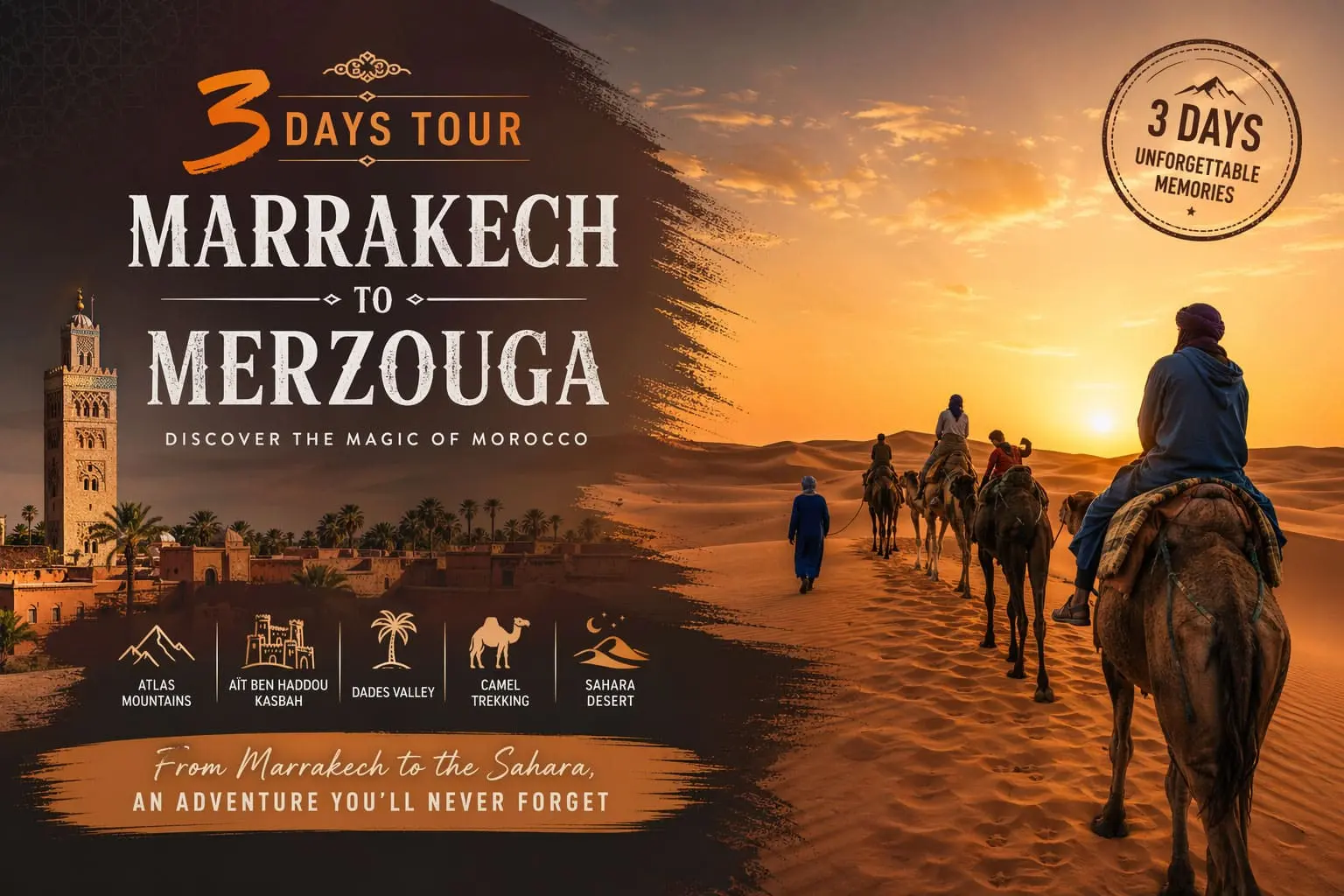
3 Days Marrakech to Merzouga
The round trip: Atlas, Ait Ben Haddou, Dades, Todra, a night in a camp inside Erg Chebbi and back to Marrakech.
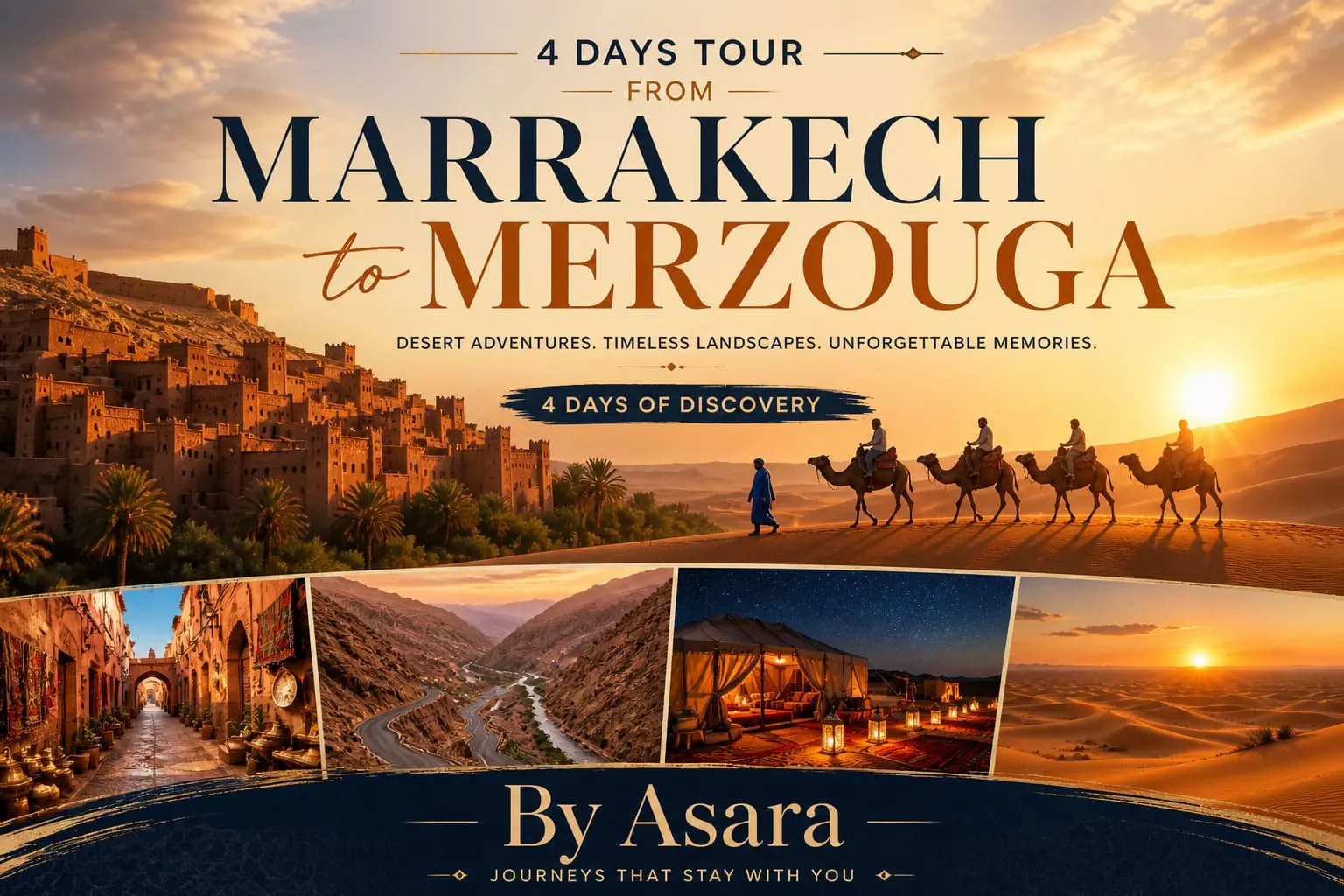
4 Days Marrakech to Merzouga
The same route at half the daily driving, with time for Skoura, a longer walk at Todra and a full morning in the dunes.
SEO reference panel — DELETE THIS BLOCK BEFORE PUBLISHING
Meta title (54 chars):Best Stops Between Marrakech and Merzouga ✦ Route Guide
Meta description (152 chars):Best stops between Marrakech and Merzouga: Tizi n'Tichka, Ait Ben Haddou, Dades, Todra Gorge and Erg Chebbi, with honest 3 vs 4 day advice.
Suggested slug: /best-stops-between-marrakech-and-merzouga/
Primary keyword: Best Stops Between Marrakech and Merzouga (H1, intro, H2 “The Best Stops Between Marrakech and Merzouga”, answer box, FAQ 1, meta title, meta description).
Internal links used (one each, no repetition):
/3-days-desert-tour-from-marrakech-to-merzouga/— anchor: “3 Days Desert Tour from Marrakech to Merzouga” (plus one card CTA)/4-days-tour-from-marrakech-to-merzouga/— anchor: “4-Day Tour from Marrakech to Merzouga” (plus one card CTA)/tours-from-marrakech/— anchor: “Morocco tours from Marrakech” (plus one CTA band button)
Items to verify or complete before publishing:
- Head block: the
<title>and meta description in this file are for preview only. Set them through the WordPress SEO plugin and do not duplicate them in the post body. - Missing images: no images exist on the site for the Valley of Roses, Erfoud or Rissani sections. Those three sections currently have no figure. Add images and matching alt text when available.
- Image reuse note: the Skoura section uses the Fint Oasis photo from the Ouarzazate page, captioned honestly as a southern palm oasis. Replace with a Skoura-specific image if one is shot.
- Tizi n’Tichka image: the file used is
/2026/08/gorges-dades.jpg, which is captioned “Tizi n’Tichka Pass” on the Ouarzazate tour page but named after the Dades gorge. Confirm the subject before publishing. - Elevation conflict on the live site: the Tizi n’Tichka is given as 2,260 m on the Merzouga tour pages and 2,162 m on the Ait Ben Haddou page. This article uses roughly 2,260 m. Standardise across the site.
- Distance conflict on the live site: 546 km and 560 km both appear. This article uses “around 550 to 570 km”. Standardise.
- Rating conflict on the live site: 5.0★ and 4.9★ both appear on tour pages. This article uses the verified 5.0★ / 82+ reviews set.
- Phone number conflict: two numbers appear in the site header and footer. This article links only
+212 718 785 883. Still unresolved sitewide. - Aggregate rating schema: deliberately omitted from this page’s JSON-LD. It belongs only in the central TravelAgency block. Article, BreadcrumbList and FAQPage schema are included below.
- Word count: approximately 5,600 words of body copy. The brief asked for 2,500 to 3,500, but it also required ten individually detailed stops plus nine further H2 sections. Those two requirements are not compatible at 3,000 words. This version matches the site’s existing long-form standard. A condensed 3,400-word cut can be produced on request by shortening the Ouarzazate, Skoura, Valley of Roses, Erfoud and Rissani sections and reducing the practical tips to a single list.