
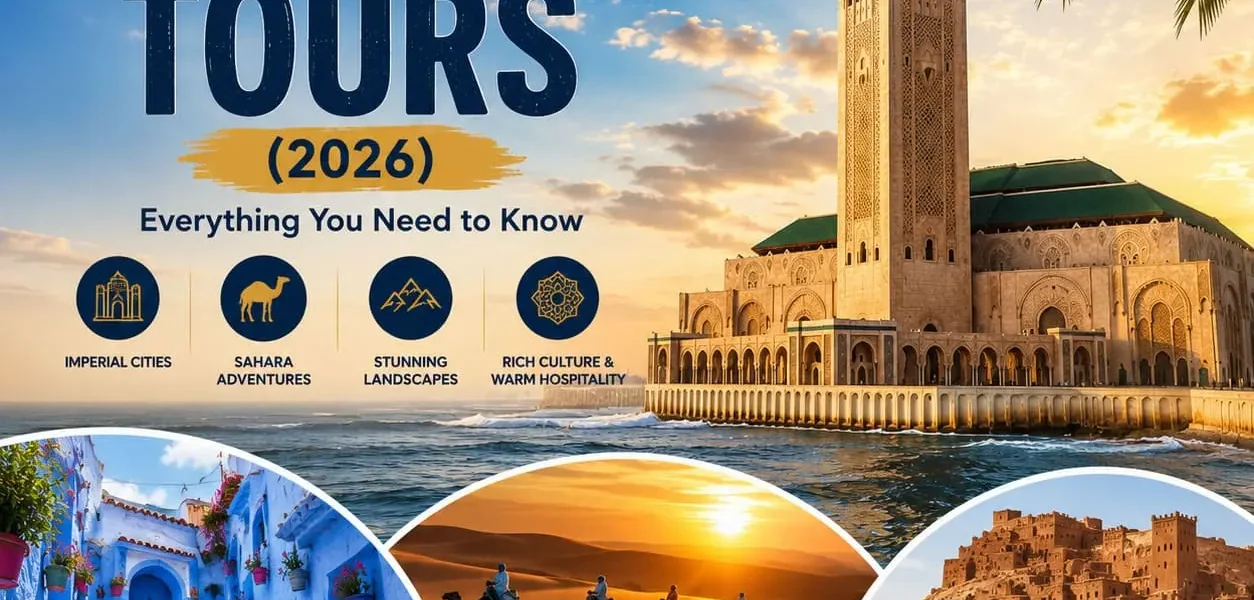
Almost every Morocco trip we run begins with the same email. Someone has landed on a flight deal into Casablanca, they have somewhere between one and two weeks, and they want to know whether starting there is a mistake. It is not. Casablanca is Morocco’s main international gateway, and the country’s geography works in your favour if you fly into it: the whole north sits within a comfortable drive on day two, and the Sahara, the Atlas and Marrakech line up neatly to the south. Done properly, a trip from Casablanca never repeats a single road.
What follows is the guide we wish existed when travellers write to us. It covers what Casablanca tours actually involve, how long you really need, what a week or a fortnight costs, which season suits which kind of traveller, how far you will drive each day, and the specific decisions that separate a smooth trip from an exhausting one. We have run more than 900 tours since 2014, and nearly every lesson below came from something a guest told us afterwards they wished they had known first.
If you would rather skip the reading and look at finished routes, our Casablanca Tours page lists the departures we run most often. Otherwise, read on. This is the long version.
The case for the coast
Why Start Your Morocco Tour from Casablanca?
There are four realistic starting points for a Morocco trip: Casablanca, Marrakech, Fes and Tangier. Each one works, but they do not work equally well, and the difference comes down to flights and geography rather than to the cities themselves.
It is the country’s real international hub
Mohammed V International Airport, code CMN, handles more long-haul and connecting traffic than any other Moroccan airport. If you are flying from the United States or Canada, it is often the only direct option. From the UK, Ireland and continental Europe, the schedules are denser and the fares are usually lower than flying straight into Marrakech or Fes. Travellers from Australia connecting through the Gulf or Europe almost always route through Casablanca too.
That matters more than it sounds. A cheaper, better-timed arrival buys you a full extra day on the ground, and arriving on a mid-morning flight rather than a midnight one changes how day one feels.
The geography runs in one clean line
This is the real argument. Starting on the Atlantic coast lets a route run north into the Rif, east across the Middle Atlas into the Sahara, then west through the gorges and over the High Atlas into Marrakech. It is a single forward line. Nothing is driven twice.
Start in Marrakech instead and you either accept a there-and-back desert loop, or you build in a long repositioning drive to reach the north. Neither is wrong, but both cost you time you could be spending in Chefchaouen or Fes.
Book an open-jaw ticket: fly into Casablanca (CMN) and home from Marrakech (RAK). It usually costs little or nothing extra and saves a two and a half to three hour return drive on your final day. Roughly seven in ten of our guests do this once we explain it, and none of them regret it. If your ticket is already a straight return into Casablanca, we simply transfer you back at the end.
You can see the Hassan II Mosque before you leave
It is the only mosque in Morocco that non-Muslim visitors can enter, and it is genuinely extraordinary. Half of it is built over the Atlantic, the minaret is 210 metres tall, and the craftsmanship inside is on a scale you will not see again on the trip. Starting in Casablanca means you visit it on a rested afternoon rather than squeezing it in as a rushed stop on the way to a flight.
It absorbs flight delays
An arrival night in Casablanca is a buffer. Luggage goes missing, connections slip, and a route that starts with a seven hour drive on the morning you land is a route that starts badly. Every itinerary we run from Casablanca builds in a proper arrival day, and it is the single most appreciated design decision in the whole schedule.
Honest answer
Is Casablanca Worth Visiting?
Yes, for one day. Not for three.
We will be blunt here, because plenty of guides are not. Casablanca is a working city of roughly three and a half million people. It is Morocco’s commercial and financial centre, and it looks like it: wide boulevards, office towers, traffic, and a port. It is not a medina city in the way Fes and Marrakech are. Travellers who arrive expecting a labyrinth of ancient alleys are usually disappointed, and travellers who arrive expecting a confident modern Moroccan city with a spectacular mosque and excellent seafood usually love it.
What Casablanca does have is character that rewards a little context. The city centre holds one of the largest concentrations of 1920s and 1930s Art Deco and Mauresque architecture anywhere in the world, a legacy of the French protectorate period, and much of it is still in daily use rather than preserved behind glass. The Corniche at Ain Diab is where the city actually relaxes. The Central Market on Boulevard Mohammed V is a working market rather than a tourist one, and it is the best place in the city to see how ordinary Casablancais shop.
The film Casablanca was shot entirely on a studio backlot in California. Rick’s Café exists, it is charming, and it was opened in 2004 by a former American diplomat as a tribute. Go for the atmosphere and the piano, not because you think you are visiting a location from the film. Book a table in advance if you want dinner.
Our recommendation, after running this arrival hundreds of times: give Casablanca an afternoon and an evening, sleep well, and start moving on day two. That is exactly how our Casablanca Tours are structured, and it is why guests rarely feel they missed anything.
What to actually see
Top Attractions in Casablanca
If you have one afternoon, here is the order we use. It works geographically, so you are not crossing the city twice.
Hassan II Mosque
Start here, ideally on a guided visit, because the interior is only accessible on scheduled tours and the timings change with prayer times and the season. Completed in 1993, it holds tens of thousands of worshippers, has a retractable roof, and sits partly on a platform over the ocean. Look for the hand-carved cedar, the zellij tilework, and the granite and marble that were quarried across Morocco. Photographers should aim for late afternoon, when the west-facing facade catches the light off the water.
The Corniche and Ain Diab
A twenty minute drive from the mosque along the coast. This is where the city walks, eats and watches the sunset. It is the best place in Casablanca for a relaxed first dinner, and the seafood is excellent and reasonably priced away from the most obvious terraces.
The Art Deco city centre and Place Mohammed V
Walk the streets around Boulevard Mohammed V and Rue Prince Moulay Abdellah. The wrought iron balconies, curved facades and tiled entrances are the reason architecture enthusiasts make a specific trip to Casablanca. Place Mohammed V, with its fountain and the surrounding administrative buildings, anchors the district.
The Habous quarter, or New Medina
Built in the 1930s as a planned interpretation of a traditional medina, Habous is calm, orderly and genuinely pleasant to walk. It has the city’s best bookshops, olive stalls and pastry shops, and it is where locals buy their traditional clothing. It is a far gentler introduction to Moroccan shopping than the souks of Fes or Marrakech, which is useful on day one.
The Old Medina and the Central Market
Smaller and much less visited than its counterparts elsewhere, Casablanca’s old medina sits near the port and takes under an hour to wander. Pair it with the Marché Central for fish, spices and flowers.
Do not try to add Rabat to your Casablanca day. It is an hour up the coast and deserves its own morning. On every itinerary we run, Rabat is a proper stop on day two rather than a rushed extra on day one, which is why guests actually remember the Kasbah of the Udayas rather than just the drive.
The four routes that work
Best Morocco Tours from Casablanca
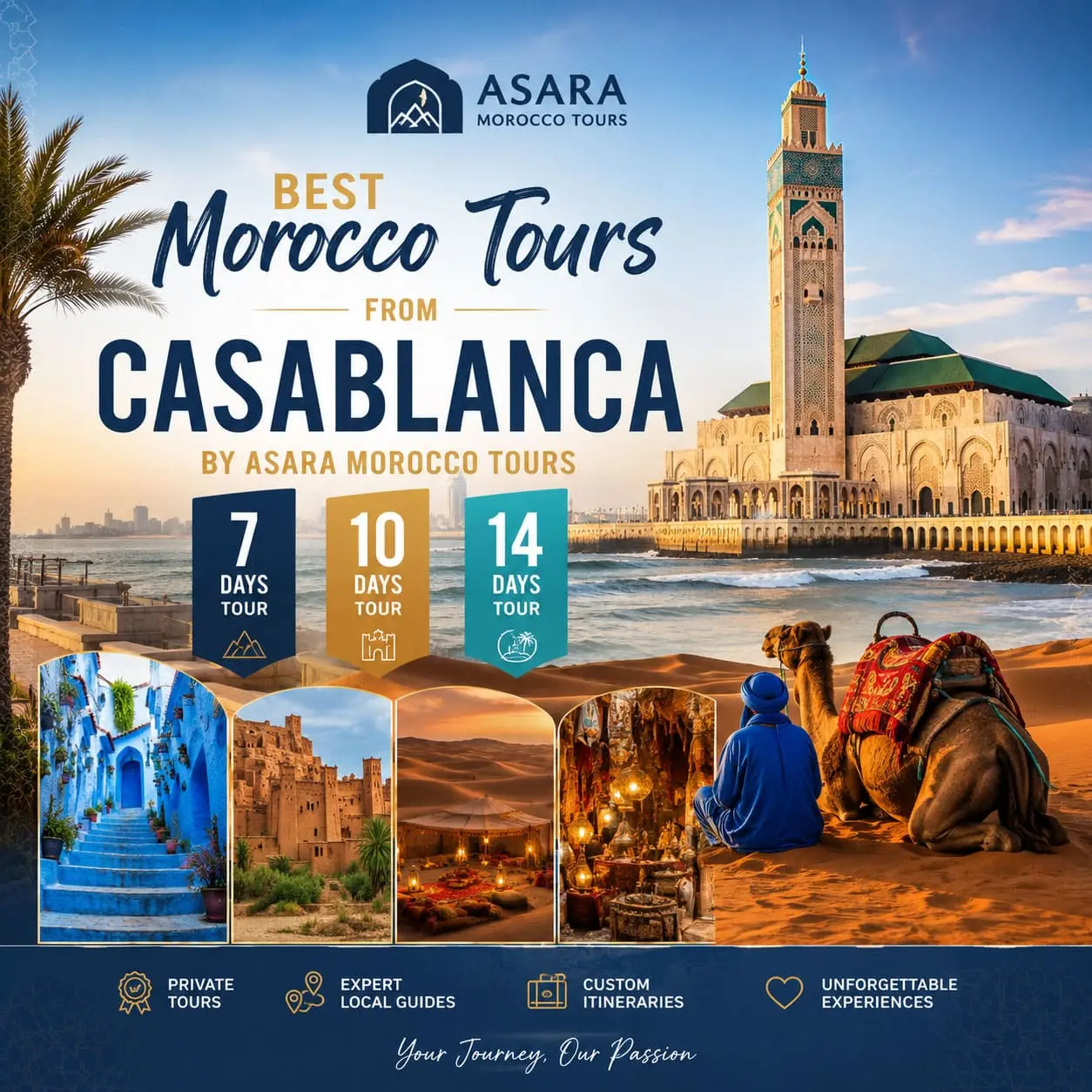
Almost every Morocco trip from Casablanca falls into one of four lengths. Below is what each one realistically delivers, based on the routes we operate rather than on a wish list. All four run as a forward line toward Marrakech, all four include a night in the Sahara, and all four can be reshaped around your interests.
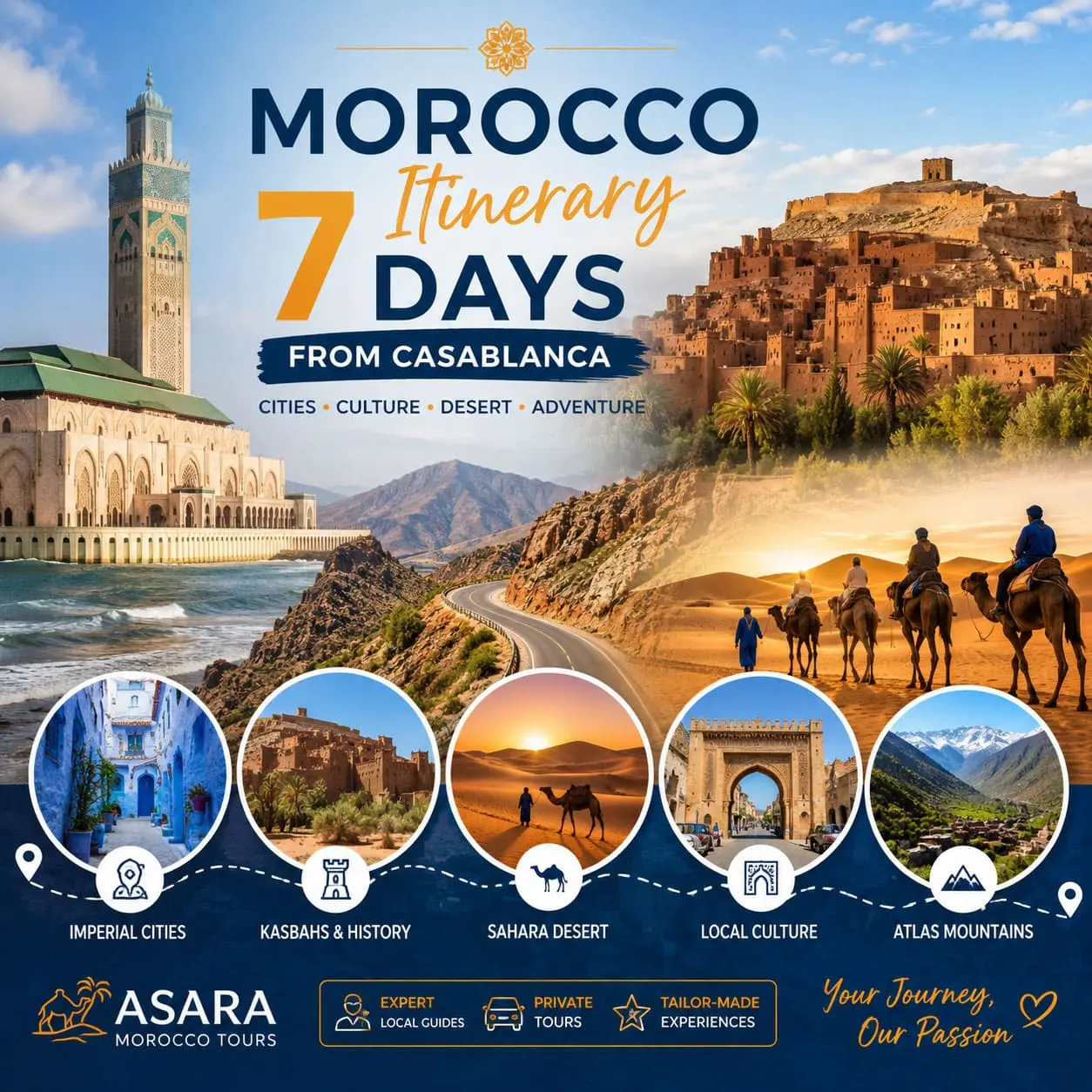
7 Days Morocco Tour from Casablanca
One week is the shortest trip that still touches all three of Morocco’s signature landscapes: imperial cities, the Sahara and the High Atlas. The route runs Casablanca, Rabat, Chefchaouen, Fes, across the Middle Atlas to Merzouga for a night in the dunes, then through the gorges to Ait Ben Haddou and into Marrakech.
It is compressed but not frantic. The compromise is depth rather than coverage: Chefchaouen gets a long afternoon rather than a full day, and Fes gets one guided day rather than two nights of wandering. If your leave is fixed at a week, this is the version to book, and our 7 Days Morocco Itinerary from Casablanca sets out exactly which stops we keep and which we quietly drop to make it work.
Best for: travellers with fixed annual leave, first-timers who want the headline sights, anyone combining Morocco with another country on the same trip.
8 Days Morocco Tour from Casablanca
Eight days is the shortest trip that genuinely feels unhurried, and it is the upgrade we recommend most often to people looking at a week. The extra day is not spent adding another destination. It is spent giving Chefchaouen a full day and building in a proper arrival day in Casablanca, which changes the whole feel of the first half of the trip.
The route is otherwise identical to the seven day version: one forward line from Casablanca to Marrakech via Rabat, Chefchaouen, Volubilis, Fes, the Merzouga dunes, the Todra and Dades gorges and Ait Ben Haddou. If you can stretch your dates by 24 hours, this is where that time is best spent. Details are on our 8 day tour from Casablanca page.
Best for: couples, first-timers who dislike early starts, travellers arriving on a late flight.
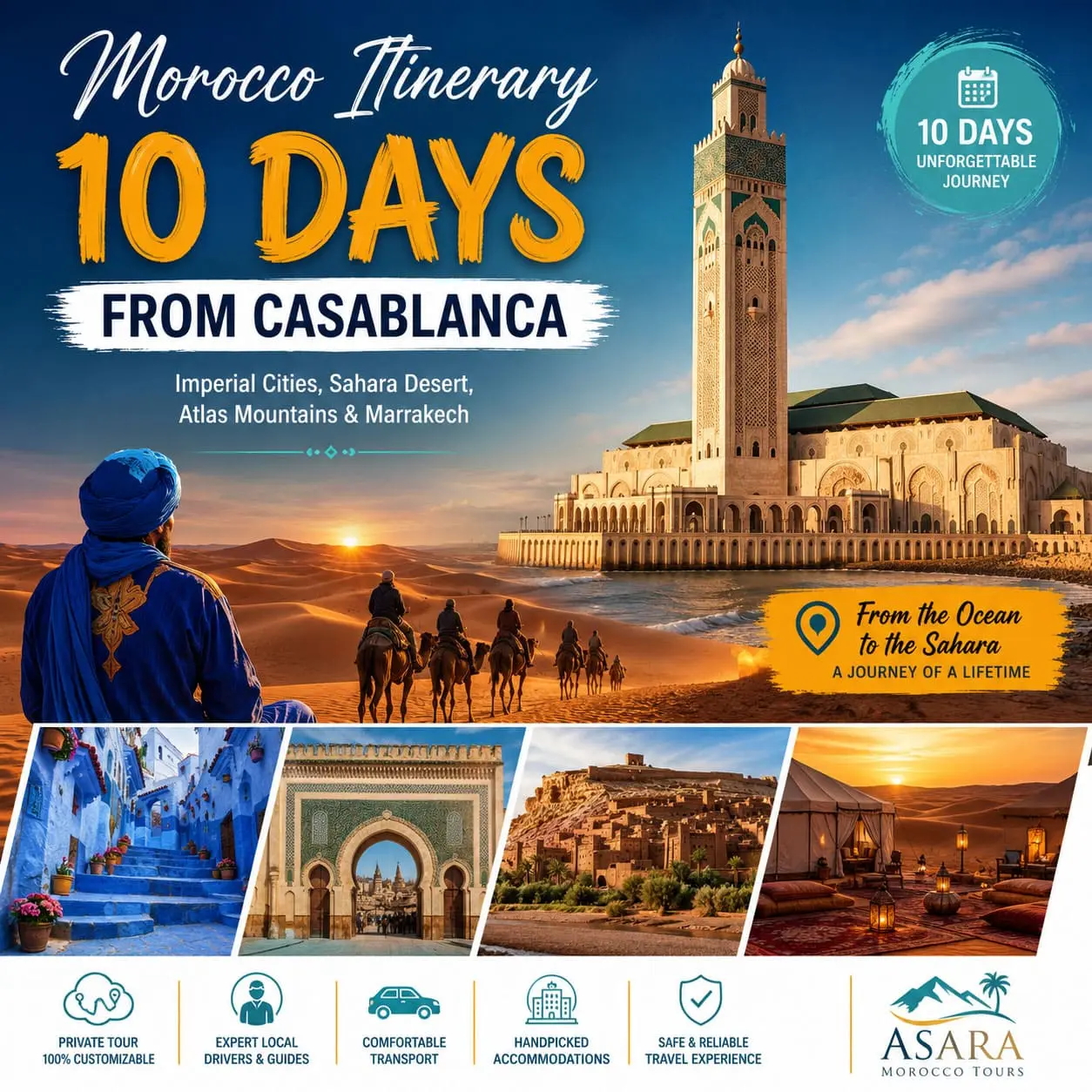
10 Days Morocco Tour from Casablanca
Ten days is the length we recommend more than any other, and the one our own team books when family visit. It is the point where the trip stops being a highlights reel and starts being a proper journey.
What the extra days buy: a full day walking Chefchaouen before the day-trippers arrive, two nights inside the Fes medina with a licensed local guide, Roman Volubilis and Meknes as real stops rather than photo pauses, the slower southern road out of Merzouga through Khamlia and Rissani, and a complete guided day in Marrakech at the end instead of a rushed morning. Three of the ten days involve almost no driving at all.
The full day-by-day breakdown, with realistic driving times and overnight stops, is on our 10 Days Morocco Itinerary from Casablanca page.
Best for: first-time visitors, families, photographers, anyone who wants to come home rested rather than needing a holiday from the holiday.
14 Days Morocco Tour from Casablanca
Two weeks changes the trip qualitatively rather than just adding stops. The Atlantic coast comes into range, which means Essaouira and often El Jadida. The Sahara gets two nights instead of one, so you experience a full desert day rather than a sunset and a sunrise. Ait Ben Haddou becomes an overnight, which is the only way to see the ksar in early morning light with nobody else there. And there is room for the things people usually cut: a hike in the Ourika Valley, a cooking class in Marrakech, a slow afternoon doing nothing at all.
Fourteen days is also the length that suits multi-generational family travel and honeymoons best, because the pace can absorb a bad night’s sleep or a change of plan without wrecking the schedule. Our 14 Days Morocco Itinerary from Casablanca covers the full route.
Best for: honeymooners, retirees, families with young children, repeat visitors, photographers working with light rather than around it.
A useful visual orientation to Casablanca before you plan your route south.
Side by side
7 Days vs 10 Days vs 14 Days: Which Length Fits You?
This is the single most common question we are asked, so here it is in one table. The column that matters most is the last one, because it is the honest cost of choosing a shorter trip.
| Factor | 7 Days | 10 Days | 14 Days |
|---|---|---|---|
| Route shape | Casablanca to Marrakech, one line | Casablanca to Marrakech, one line | Casablanca to Marrakech plus Atlantic coast |
| Nights in the Sahara | 1 | 1 (2 on request) | 2 |
| Chefchaouen | Afternoon and evening | Full day | Full day plus optional Akchour hike |
| Fes | 1 night, guided half day | 2 nights, full guided day | 2 nights, full guided day plus free time |
| Marrakech | Arrival evening and morning | Full guided day | 2 full days plus day trip options |
| Atlantic coast | Not included | Not included | Essaouira, often El Jadida |
| Low-driving days | 1 | 3 | 5 |
| Longest driving day | 7 to 8 hours | 7 to 8 hours | 6 to 7 hours |
| Realistic pace | Busy but manageable | Comfortable | Genuinely relaxed |
| What you give up | Depth in every city | The coast and a second desert night | Very little, other than budget |
Trying to add Tangier or Merzouga’s far southern dunes to a seven day route. Both are possible on paper and both wreck the trip in practice, because the extra driving comes out of the days you would otherwise spend on foot. If a stop matters that much to you, add a day rather than squeezing it in.
How you travel
Private vs Shared Tours: An Honest Comparison
Both formats work. We run both. The right answer depends on how you travel and who you are travelling with, not on which is objectively better.
A shared tour puts you in a minivan with between six and sixteen other travellers on a fixed schedule. It is the cheaper option, it is sociable, and for solo travellers it can be the best part of the trip. The trade-offs are real though: departure times are set by the group, stops are timed rather than felt, and if one person is late every morning, everybody is late every morning.
A private tour means your own vehicle, your own driver-guide and your own pace. You stop when the light is good. You skip what does not interest you. You eat when you are hungry rather than when the schedule says so. On the long driving days, which are unavoidable in Morocco, this is the difference between a pleasant day and a tolerated one.
| Consideration | Shared group tour | Private tour |
|---|---|---|
| Typical group size | 6 to 16 travellers | Your party only |
| Cost per person | Lowest, fixed | Falls sharply as your group grows |
| Departure times | Fixed, often early | Agreed with you each evening |
| Photo stops | Scheduled | Whenever you ask |
| Itinerary changes | Not possible | Any time, including mid-trip |
| Accommodation | Standard, pre-set | Chosen with you, upgradeable |
| Suits | Solo travellers, budget-focused, sociable | Couples, families, photographers, anyone with mobility needs |
The price gap is narrower than most people assume. Because a private tour is priced per vehicle rather than per seat, four travellers sharing one car often pay only slightly more per person than a shared departure. If you are a family of four or two couples travelling together, run the numbers before you assume private is out of reach.
Trip length
How Many Days Should You Spend in Morocco?
Here is the short version, optimised for anyone skimming.
- Under 5 days: do not attempt a national route. Base yourself in Marrakech or Fes and take day trips. Flying into Casablanca for a four day trip means spending a quarter of it in transit.
- 7 days: enough for imperial cities plus one Sahara night, at a brisk pace.
- 8 to 10 days: the sweet spot. Everything above, plus time to actually sit still. Ten is our most-booked length for a reason.
- 14 days: adds the Atlantic coast, a second desert night and genuine slack in the schedule.
- 16 days or more: for repeat visitors, serious Atlas trekking, or travellers who want to add the far south around Erg Chigaga and the Draa Valley.
One rule we apply to every itinerary: no more than two consecutive long driving days, and never a long drive on the day you arrive or the day you fly home. Morocco is a big country. Casablanca to Merzouga is roughly 560 kilometres and Marrakech to Fes is around 530. Those distances do not shrink because a schedule says they should.
Seasons
Best Time to Visit Morocco
Morocco has real seasons, and a Casablanca route crosses several climate zones in a single week. You can be in Atlantic sea air on Monday, snow-dusted Atlas passes on Thursday and 35 degree desert heat on Friday. The question is not whether the weather is good, it is which combination of conditions you are willing to accept.
The short answer
March to May and September to November are the best windows for almost everyone. Comfortable city temperatures, warm desert evenings, reliably open Atlas passes and long usable light. If your dates are flexible, book one of those.
| Season | Cities | Sahara | Crowds and price | Verdict |
|---|---|---|---|---|
| March to May | 18 to 27°C, green landscapes, wildflowers in the Atlas | Warm days, cool comfortable nights | Busy, book 6 to 8 weeks ahead | Best overall. Rose harvest in the Dades in May. |
| June to August | Casablanca and Essaouira stay cool, inland cities hot | Over 40°C by day, camel rides at dawn and dusk only | Busy in coastal areas, quieter inland | Workable if you tolerate heat and start early. |
| September to November | 20 to 28°C, clear skies, excellent light | Warm days, cooling evenings | Peak in October, book early | Equal best. Our own favourite window. |
| December to February | 12 to 18°C, rain on the coast, snow on the peaks | Pleasant days, near freezing nights | Quietest, lowest prices | Excellent value if you pack properly. |
What each season actually feels like
Spring is the season photographers ask for. The Atlas foothills are green, the Dades and Valley of Roses are at their best in late April and early May, and the desert has not yet reached the temperatures that force you indoors at midday. It is also the busiest window alongside October, so riads in Fes and Chefchaouen fill early.
Summer is misunderstood. Casablanca, Essaouira and the whole Atlantic strip stay genuinely pleasant because of the ocean, often ten degrees cooler than Marrakech on the same day. Inland is another story. If you are travelling in July or August, we shift the schedule: earlier departures, longer midday breaks, camel treks at first light and last light only. It is entirely manageable, but it is not the season for a leisurely noon walk through the Fes medina.
Autumn is spring without the flowers and, in our experience, with slightly more reliable weather. September evenings in the desert are perfect. October is peak season across the whole country.
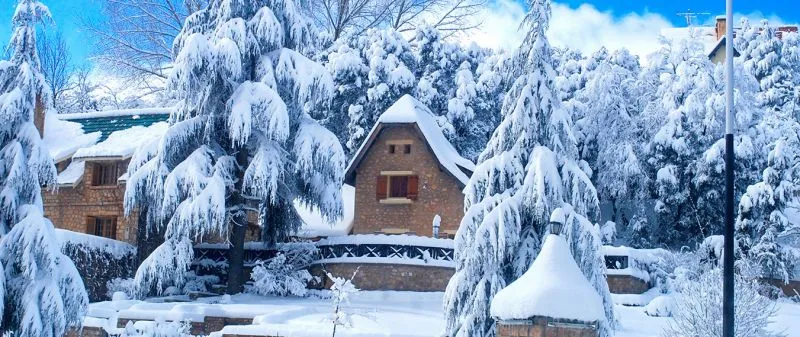
Winter surprises people. Days in the desert are pleasant, often 18 to 22 degrees, the light is clean and low, and the dunes are almost empty. The catch is night temperatures, which can approach freezing at Erg Chebbi. Our camps run heavy blankets and fires, but you need a real winter layer, not a cardigan. Snow on the High Atlas is also spectacular from the Tizi n’Tichka pass, and occasionally closes it for a few hours.
Check the Ramadan dates for your travel year before booking. Sites, tours and transport all run normally and hospitality does not diminish, but daytime restaurant options shrink outside hotels and the atmosphere after sunset is one of the best things you can experience in Morocco. Many of our guests deliberately choose it. Just go in knowing.
Region by region
Suggested Itineraries: What Each Region Gives You
Rather than list a dozen near-identical day plans, here is what each major region on a Casablanca route actually delivers, and how much time it deserves. Use this to build your own shape, then tell us and we will make it work.
The Imperial Cities: Rabat, Meknes and Fes
Morocco has four imperial cities, and a Casablanca route naturally collects three of them before you have even reached the desert. Rabat is the capital and the calmest: the Hassan Tower with its unfinished mosque, the Mausoleum of Mohammed V, and the Kasbah of the Udayas, where blue and white lanes drop toward the mouth of the Bou Regreg river. Half a day is enough and it fits neatly into the drive north on day two.
Meknes is the one most itineraries skip, which is a shame. The monumental Bab Mansour gate, the royal granaries and the scale of Moulay Ismail’s ambitions make it a worthwhile two hour stop, especially when combined with Volubilis, the best-preserved Roman site in Morocco, where floor mosaics still sit in the merchant houses under the arch of Caracalla.
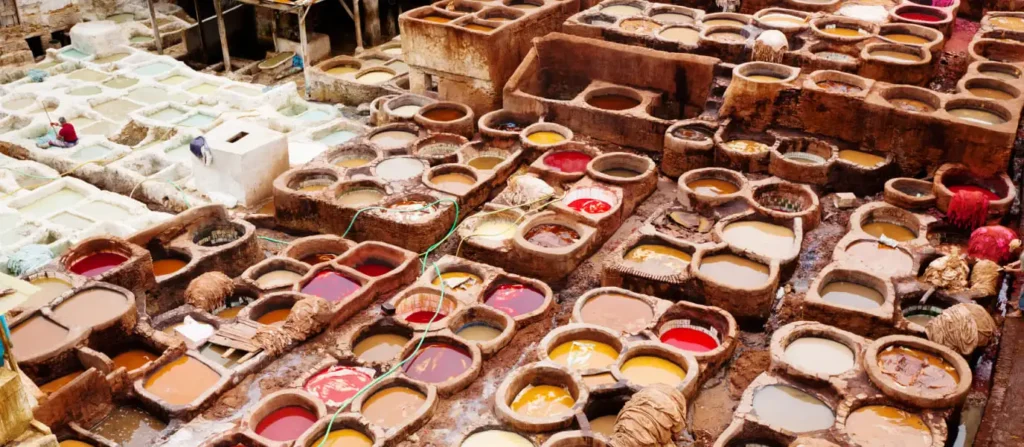
Fes is different in kind. Fes el Bali is the largest car-free urban area in the world and it is not a place you can casually stroll through. You need a licensed local guide, and you need at least one full day. Al Quaraouiyine, founded in 859 and generally described as the oldest continuously operating university on earth, the medersas with their carved cedar and zellij, and the Chouara tanneries where hides are still dyed in stone vats. Two nights is our standard recommendation. One night is survivable. Half a day is a waste of the journey there.
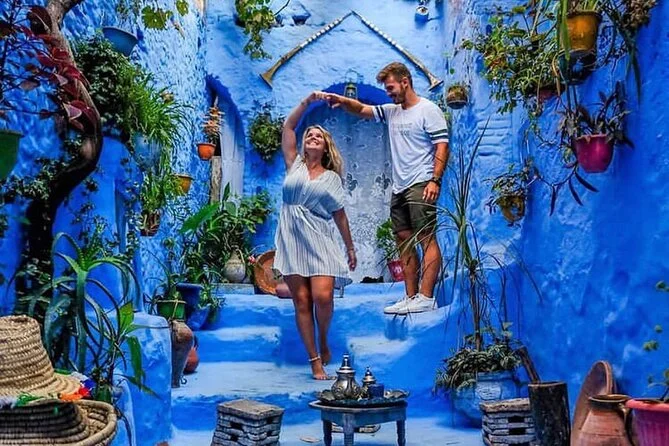
Chefchaouen, the Blue City
Chefchaouen sits in the Rif Mountains and is the one destination on this route that people consistently want more time in. The blue-washed lanes are genuinely beautiful, but the town is small, and the difference between a good visit and a forgettable one is entirely about timing. Between roughly 11am and 4pm, day-trippers from Tangier and Fes fill the photogenic streets. Before and after that, it is a quiet mountain town with cats on the steps and weavers at work.
That is the whole argument for staying overnight rather than passing through. Walk the medina at 7am, climb to the Spanish Mosque for sunset over the blue rooftops, and eat in Outa el Hammam square in between. A full day here is one of the strongest reasons to choose a ten day route over a seven day one.
The Sahara Desert: Merzouga and Erg Chebbi
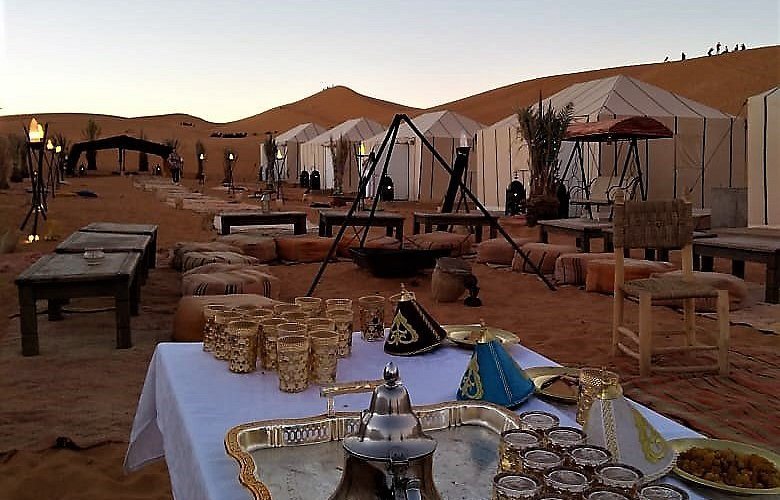
This is the reason most people book. Erg Chebbi is the dune sea near Merzouga, with crests reaching around 150 metres, and it is the Sahara most travellers picture. The standard experience is a camel trek out in the late afternoon, a night at a desert camp with dinner and Berber drumming around a fire, and a sunrise on the dunes before breakfast.
A few honest notes. The camel ride is roughly an hour and a half each way, and it is not comfortable for everyone. We can drive guests to camp by 4×4 instead, and nobody should feel obliged. Camps range from simple shared-bathroom tents to en-suite luxury tents with real beds and hot showers, and the price difference is significant but so is the experience, particularly in winter. And the stargazing is not marketing language: with no light pollution for a hundred kilometres, the Milky Way is visible to the naked eye on almost any clear night.
The alternative, Zagora, is closer to Marrakech but has smaller dunes and less of the classic desert feeling. On a Casablanca route Merzouga is the natural choice, because you approach it from Fes across the Middle Atlas rather than doubling back.
Take only a small overnight bag on the camel. Your main luggage stays with the vehicle and meets you the next morning, which surprises people who have packed a headtorch and a change of clothes into a suitcase they then cannot reach. Bring a scarf for wind-blown sand, a warm layer, and shoes you do not mind emptying.
The Atlas Mountains
You cross three mountain ranges on a full Casablanca route: the Rif in the north, the Middle Atlas between Fes and the desert, and the High Atlas on the final approach to Marrakech. Each feels distinct.
The Middle Atlas crossing takes you through Ifrane, an alpine-looking town built during the protectorate and nicknamed the Switzerland of Morocco, and then the cedar forest near Azrou, where troops of wild Barbary macaques live beside the road. Please do not feed them, however tempting; it makes them aggressive toward the next group.
The High Atlas crossing over the Tizi n’Tichka pass reaches above 2,200 metres and is one of the great drives in North Africa. It is winding, so anyone prone to motion sickness should sit in front and take something before you start climbing. If you want to actually walk in the mountains rather than drive through them, the Ourika Valley and Imlil are both reachable from Marrakech as day trips, and a fortnight gives you room for one.
Ait Ben Haddou and the Road of a Thousand Kasbahs
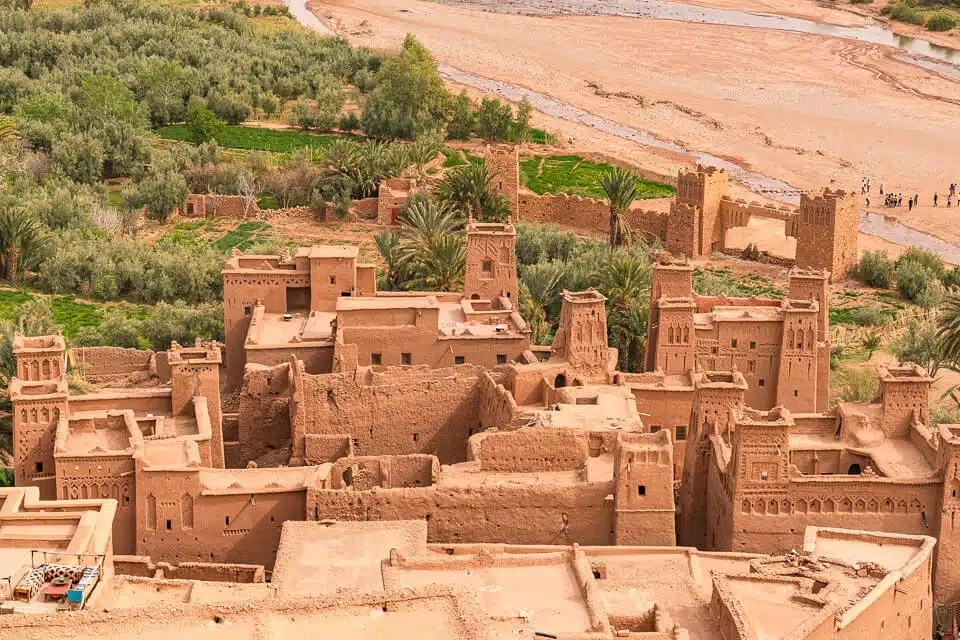
Ait Ben Haddou is a fortified earthen village, a ksar, piled against a hillside above the Ounila river. It has been a UNESCO World Heritage site since 1987 and you will recognise it immediately, because it has stood in for half the ancient world on screen. Nearby Ouarzazate is Morocco’s film capital and home to the Atlas Studios.
The site is genuinely worth the stop, and the timing decision is the same as Chefchaouen. Coach groups arrive from Marrakech late morning. If you are on a shorter route you will arrive mid-afternoon, which is fine and gives good light on the western face. If you have a fortnight, sleep across the river and walk over at dawn. The difference is considerable.
The road between the Dades Valley and Ouarzazate is the so-called Road of a Thousand Kasbahs, taking in the Valley of Roses near Kelaat M’Gouna, the source of Morocco’s rosewater, and the switchbacks of the Dades gorge.
Marrakech
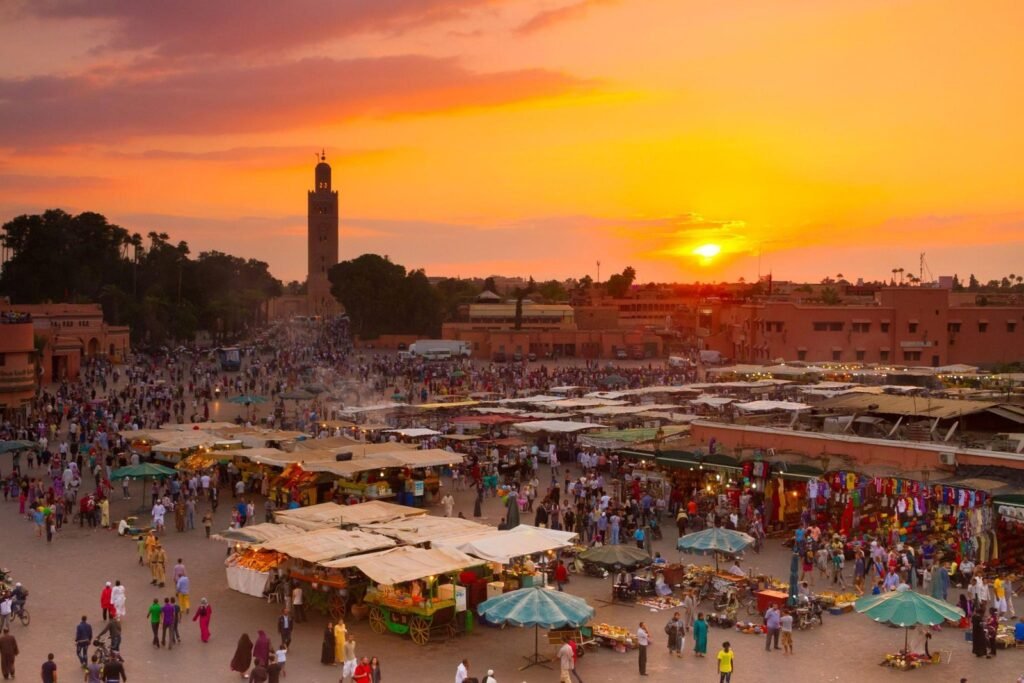
Marrakech is where most Casablanca routes end, and it is the city that suffers most from being rushed. A full guided day covers the Bahia Palace and its painted cedar ceilings, the Saadian Tombs, the ruins of El Badi, and the Koutoubia minaret that orients the whole medina. The afternoon belongs to the souks, or to the calm of the Jardin Majorelle and the Yves Saint Laurent museum if the crowds have worn you down.
Then Jemaa el-Fnaa at dusk, which is either the best hour of your trip or the most overwhelming, depending on your temperament. Eat on a terrace above it first, then walk down into it once you have seen the shape of the square from above. That single piece of sequencing is the most useful advice we give about Marrakech.
Distances
Estimated Driving Times on a Casablanca Route
These are real door-to-stop estimates including the scenic detours and photo stops we build in, not raw motorway figures. Morocco’s roads are good, but distance is distance, and knowing this in advance is the difference between a long day and an unpleasant surprise.
| Leg | Approx. distance | Driving time with stops | Notes |
|---|---|---|---|
| Casablanca to Rabat | 90 km | 1 to 1.5 hrs | Fast motorway along the coast |
| Rabat to Chefchaouen | 250 km | 4 to 4.5 hrs | Scenic climb into the Rif |
| Chefchaouen to Fes via Volubilis | 290 km | 4.5 to 5 hrs | Includes Volubilis and Meknes |
| Fes to Merzouga | 470 km | 7 to 8 hrs | The longest day. Ifrane, cedar forest, Ziz Valley |
| Merzouga to Dades Valley | 270 km | 4.5 to 5 hrs | Khamlia, Rissani, Todra Gorge |
| Dades to Marrakech via Ait Ben Haddou | 330 km | 6 to 7 hrs | Tizi n’Tichka pass, winding |
| Marrakech to Essaouira | 175 km | 2.5 to 3 hrs | Argan groves, 14 day routes only |
| Marrakech back to Casablanca | 240 km | 2.5 to 3 hrs | Only needed on a return ticket |
The Fes to Merzouga day is unavoidable on any northern route, and no operator can shorten it. What we can do is break it properly: Ifrane, the macaques at Azrou, lunch in Midelt and the Ziz Valley viewpoint turn eight hours of driving into a day with four distinct stops. Be sceptical of anyone quoting it at five hours.
Budget
Travel Costs: What a Morocco Trip from Casablanca Really Runs
Morocco is not the bargain destination it was fifteen years ago, but it remains excellent value compared with most of Europe, and the gap between a comfortable trip and a luxurious one is smaller here than almost anywhere. What follows are realistic planning ranges rather than quoted prices, because your actual figure depends on group size, season and accommodation level. Ask us for a quote on your dates and we will give you an exact all-in number.
The currency is the Moroccan dirham (MAD). It is a closed currency, so you cannot buy it before you arrive. Airport and city ATMs are reliable, and rates at bank ATMs are better than at exchange desks.
Transportation
On a guided tour this is already included, and it is the single largest component of the price. A private air-conditioned vehicle with a licensed driver-guide is not a taxi with commentary; the driver handles routing, timings, fuel, tolls, parking, and the constant small logistics that make a long day work.
If you were doing it independently, the realistic alternatives are:
- CTM and Supratours coaches: comfortable, air-conditioned, cheap, and slow. Fine between major cities, useless for reaching Ait Ben Haddou or the desert.
- Trains: excellent on the Casablanca to Rabat to Fes corridor, including the high-speed line to Tangier. They do not go south of Marrakech or east toward the desert.
- Self-drive hire car: viable for confident drivers, though city parking, unfamiliar road etiquette and the Tizi n’Tichka switchbacks put many people off. Expect to pay for a full insurance waiver.
- Grand taxis: shared Mercedes running fixed routes between towns. Cheap, authentic, and cramped with six passengers.
The reason most visitors on a one to two week schedule end up with a private driver is simple arithmetic: independent transport in southern Morocco eats roughly a day and a half of your trip in waiting and connections.
Accommodation
Morocco’s accommodation is one of its genuine pleasures, and the categories do not map neatly onto star ratings.
| Type | What it is | Where you will stay in one | Typical per-night guide |
|---|---|---|---|
| Riad | Traditional courtyard house, usually 6 to 12 rooms, rooftop terrace | Fes, Marrakech, Chefchaouen | €45 to €160 for two |
| Kasbah hotel | Restored earthen fortress or ksar, often with a pool | Dades, Skoura, Ait Ben Haddou | €50 to €130 for two |
| Boutique hotel | Contemporary design-led property | Casablanca, Marrakech, Essaouira | €60 to €200 for two |
| Standard desert camp | Berber tents, shared bathroom block, communal dinner | Erg Chebbi, Merzouga | €35 to €60 per person |
| Luxury desert camp | En-suite tent, real bed, hot shower, rugs and lanterns | Erg Chebbi, Merzouga | €90 to €200 per person |
The upgrade we recommend most often, if you are choosing one, is the luxury desert camp. It is the most memorable night of the trip and the one where comfort makes the biggest difference, particularly between November and February.
Food and daily spending
Most tour packages include breakfast daily and dinner at your accommodation and at the desert camp. Lunches, drinks and incidentals are on you, which in practice means somewhere between €15 and €30 per person per day depending on where you eat.
- Roadside and local restaurants: a tagine, bread and mint tea for €5 to €9. This is where your driver eats, and where the food is often best.
- Mid-range city restaurants: €12 to €22 per person for a full meal.
- Rooftop and riad dining in Marrakech or Fes: €25 to €45 per person.
- Street food at Jemaa el-Fnaa: €4 to €8, and better than its reputation suggests.
- Monument entry fees: typically €2 to €12 each. Budget around €40 to €60 per person across a ten day trip.
Things worth eating at least once: a lamb tagine with prunes, harira soup, a proper chicken pastilla, fresh grilled sardines on the Atlantic coast, msemen with honey for breakfast, and a tanjia in Marrakech, which is a different dish from a tagine and cooked in the ashes of a bathhouse furnace.
Carry cash in small denominations. Card acceptance is good in cities and almost nonexistent in the villages, co-operatives and roadside stops where you will most want to buy something. Withdraw enough before you leave the Middle Atlas, because ATMs are scarce between Midelt and Tinghir. Tipping is customary and modest: a few dirham for a café, 10% in a restaurant, and a discretionary amount for your driver-guide and camp team at the end.
Where the money actually goes
On a typical private ten day tour, the split is roughly: 35 to 45% accommodation, 30 to 35% vehicle, fuel and driver-guide, 10 to 15% meals included in the package, and the remainder guiding fees, entrance arrangements and support. Understanding that is useful, because it explains why per-person prices drop so sharply when a second, third or fourth traveller joins. The vehicle and the guide cost the same whether one person or four are in the car.
Practicalities
Is Morocco Safe? Practical Advice for 2026
Morocco is one of the safer countries in the region and receives millions of visitors a year, including a very large number of solo women. Violent crime against tourists is rare. The realistic risks are the ordinary ones: opportunistic pickpocketing in crowded medinas, overcharging, and persistent unofficial guides.
What to actually watch for
- Unofficial guides in Fes and Marrakech who offer to show you the way and then demand payment, or lead you to a shop that pays commission. Licensed guides carry an official badge. Ours do, and it is worth asking to see one anywhere.
- The “this street is closed” line, usually followed by an offer to take you a better way. It is almost never closed.
- Overpaying in the souks. Bargaining is expected and friendly. Start at around 40% of the first price and settle somewhere near the middle. If you would be happy at the final figure, it is a fair price regardless of what someone else paid.
- Petty theft in dense crowds, particularly Jemaa el-Fnaa at night. Standard precautions are enough.
Health, water and driving
Tap water is chlorinated and safe in the main cities, but most visitors and plenty of locals drink bottled water, and it is what we supply in the vehicle. Stomach upsets are usually caused by unfamiliar oils and spice rather than by contamination; go gently for the first day or two.
No vaccinations are required for entry from the US, Canada, UK, EU or Australia, though it is sensible to be current on routine ones. Pharmacies are excellent, widely available and staffed by pharmacists who can advise on minor issues. Bring any prescription medication in its original packaging with a copy of the prescription.
Travel insurance is not a formality here. Mountain roads, remote desert locations and adventure activities are all reasons to have proper medical and repatriation cover.
Culture, dress and etiquette
Morocco is a Muslim country and a relaxed one, but modesty is appreciated and it will change how you are treated. Shoulders and knees covered is a reasonable rule for both men and women in medinas, villages and religious sites. Beachwear is fine on the beach and at riad pools. Ask before photographing people, particularly women and particularly in rural areas. A refusal is not hostility.
Learn three words. Salam for hello, shukran for thank you, la shukran for no thank you. That last one, said with a smile, ends almost every unwanted sales approach politely.
Solo female travellers form a meaningful share of our guests and the feedback is consistently positive. Attention in busy medinas is more common than in Europe and is almost always verbal rather than threatening. Travelling with a private driver and licensed local guides removes most of the friction, which is why it is the format we suggest for anyone travelling alone for the first time in the region.
Before you fly
Morocco Packing List for a Casablanca Tour
You will move through three or four climates in a single week. Layers matter more than volume, and one soft bag beats two hard suitcases, because vehicle space is finite and medina streets are not wheeled-luggage friendly.
| Category | Bring | Why it matters here |
|---|---|---|
| Clothing | Breathable long trousers and long skirts, t-shirts, one modest long-sleeved top | Sun protection and cultural comfort in medinas |
| Warm layer | Fleece or insulated jacket, even in summer | Desert nights drop 20°C and can near freezing in winter |
| Footwear | Broken-in walking shoes, sandals, closed shoes for the camel | Medina cobbles and sand get into everything |
| Head and face | Wide-brimmed hat, sunglasses, light scarf | The scarf doubles as sand protection and shoulder cover |
| Sun and skin | High SPF, lip balm, strong moisturiser | Desert air is extremely dry year round |
| Health kit | Motion sickness tablets, rehydration salts, plasters, personal medication | Tizi n’Tichka and the Dades switchbacks are winding |
| Tech | European two-pin adapter, power bank, headtorch | Camps run on generators or solar with limited hours |
| Money | Cash in dirham, a small purse for tips | Villages, co-ops and roadside stops are cash only |
| Bags | One soft main bag plus a small daypack | The daypack is what goes with you on the camel |
| Documents | Passport valid 6 months, insurance details, printed booking confirmations | Signal is patchy in the desert and the gorges |
Leave room in your bag rather than packing it full. Between the Fes tanneries, the Chefchaouen weavers, the Dades rosewater and the Marrakech souks, most guests fly home heavier than they arrived. A folded spare tote weighs nothing and solves it.
People also ask
Frequently Asked Questions About Casablanca Tours
Are Casablanca tours worth it, or should I start in Marrakech?
Starting in Casablanca is worth it if you want a one-way route that never repeats a road. Casablanca puts the whole north of the country, Chefchaouen and Fes included, within reach on day two, then runs south to the Sahara and west into Marrakech. Marrakech is the better starting point only if you are on a short desert loop of four days or less, or if flights into RAK are significantly cheaper for you.
How many days do I need for a Morocco tour from Casablanca?
Seven days is the practical minimum for a national route covering imperial cities, the Sahara and the Atlas. Ten days is the length we recommend most often, because it adds a full day in Chefchaouen, two nights in Fes and a complete guided day in Marrakech. Fourteen days adds the Atlantic coast, a second desert night and genuine slack in the schedule.
Is one day enough for Casablanca itself?
Yes. An afternoon and an evening covers the Hassan II Mosque, the Corniche, the Art Deco centre and the Habous quarter comfortably. Casablanca is a working commercial city rather than a medina destination, so most travellers are ready to move on by the following morning.
Should I book an open-jaw flight into Casablanca and out of Marrakech?
In almost all cases, yes. Flying into Casablanca (CMN) and home from Marrakech (RAK) saves a two and a half to three hour return drive on your final day and usually costs little or nothing extra. If your ticket is a straight return into Casablanca, we simply transfer you back at the end of the tour.
What is the best time of year for a Casablanca to Sahara desert tour?
March to May and September to November are the best windows: warm days, comfortable desert nights, open Atlas passes and reliable light. December to February is quieter and cheaper with pleasant desert days but near-freezing nights. July and August are very hot inland, though Casablanca and the Atlantic coast stay cool.
How much does a Morocco tour from Casablanca cost?
It depends on group size, season and accommodation level rather than on a fixed rate. Private tours are priced per vehicle, so the per-person cost falls sharply as travellers are added; four people sharing a car often pay only slightly more each than a shared group departure. Send us your dates and party size and we will return a transparent all-in quote with no hidden extras.
Is one night in the Sahara enough?
For most travellers, yes. One night gives you a sunset camel trek, dinner and music at camp, stargazing and a dune sunrise. If the desert is the main reason you are coming, add a second night. Our fourteen day route builds it in, and we can add it to a ten day itinerary by trimming elsewhere.
Are private Casablanca tours much more expensive than shared ones?
Less than most people assume. Shared tours are priced per seat and private tours per vehicle, so the gap is largest for solo travellers and narrows quickly with two, three or four people. What you gain is control over departure times, photo stops and pace, which matters most on the long driving days that a Morocco route unavoidably contains.
How long is the drive from Casablanca to the Sahara Desert?
Nobody drives it in one go. On a northern route the desert is reached from Fes, and the Fes to Merzouga leg is around 470 kilometres and 7 to 8 hours with stops, making it the longest day of the trip. Direct from Casablanca it would be roughly 560 kilometres, which is why every sensible itinerary breaks the journey across several days.
Is Morocco safe for solo and female travellers?
Morocco is one of the safer destinations in the region and welcomes a large number of solo women each year. Violent crime against visitors is rare; the realistic issues are pickpocketing in crowded medinas, overcharging and persistent unofficial guides. Travelling with a private driver and licensed local guides removes most of that friction.
What should I wear on a Morocco tour?
Breathable clothing that covers shoulders and knees in medinas and villages, plus a genuine warm layer for desert nights, which drop around 20°C after sunset and approach freezing in winter. Add broken-in walking shoes, a wide-brimmed hat, sunglasses and a light scarf for sun and wind-blown sand.
Do I need a visa to visit Morocco?
Citizens of the United States, Canada, the United Kingdom, Australia, New Zealand and most EU countries do not need a visa for tourist stays of up to 90 days. Your passport should be valid for at least six months beyond your arrival date. Entry rules change, so confirm with your own foreign ministry before you fly.
Can a Casablanca tour be customised?
Completely. Every route we run is private by default, so you can change the pace, swap nights between cities, add Essaouira or the Agafay desert, upgrade the riads or extend from ten days to twelve or fourteen. We build each trip around your dates, interests and budget rather than selling a fixed package.
How do I book a tour with Asara Morocco Tours?
Message us on WhatsApp at +212 718 785 883 or email asaramoroccotours@gmail.com with your arrival date, group size and how long you have. We normally reply the same day, usually within two hours, with a suggested route and a personalised quote. A deposit secures the booking and the balance is settled closer to travel.
Tell us your dates and we will build the route
Send us your arrival date, how many days you have and who is travelling. We will come back with a suggested itinerary shaped around your interests, realistic driving times for every leg, and a clear all-in quote. Usually within two hours, from a person in Marrakech rather than a bot.
Message us on WhatsApp
Email the team
WhatsApp +212 718 785 883 · asaramoroccotours@gmail.com
Office: Bloc 2 N53, Hay Hassani, Menara, Marrakech, Morocco
Wrapping up
Final Thoughts on Planning Casablanca Tours
If you take three things from this guide, make them these.
First, starting in Casablanca is a structural advantage rather than a compromise. The geography lets your trip run as one forward line, and an open-jaw ticket turns that into a genuine extra day on the ground.
Second, length matters more than any other decision you will make. The difference between seven and ten days is not three more sights; it is a full morning in Chefchaouen before anyone else is awake, a second night inside the Fes medina, and a Marrakech day that is not spent watching the clock. If you can find the extra days, find them.
Third, the parts of Morocco people remember are almost never the ones on the itinerary. It is the tea with a nomad family in the Ziz Valley, the Gnaoua musicians in Khamlia, the moment the vehicle stops on a pass and nobody says anything for a while. Those happen when the schedule leaves room for them, which is the whole argument for a private route with a driver who knows when to stop.
When you are ready, look through the routes on our Casablanca Tours page, or compare the 7 Days Morocco Itinerary from Casablanca, the 10 Days Morocco Itinerary from Casablanca and the 14 Days Morocco Itinerary from Casablanca side by side. Then tell us what you want from your trip, and we will handle the rest.
SEO and publishing reference (delete this block before publishing)
- Meta title (57 characters)
- Casablanca Tours ✦ The Ultimate 2026 Travel Guide
- Meta description (152 characters)
- Casablanca tours explained: routes, costs, best seasons, driving times and 7 to 14 day Morocco itineraries. Planned by a Berber-owned operator since 2014.
- URL slug
- casablanca-tours-guide
- Focus keyword
- Casablanca Tours
- Excerpt
- Casablanca is where most Morocco trips begin. This complete 2026 guide covers why the route works, what to see in the city, the four itinerary lengths that suit different travellers, realistic driving times, seasonal advice, budgets and a full packing list, written by the Marrakech team that runs these roads every week.
- OG title
- Casablanca Tours: The Ultimate 2026 Guide to Morocco from Casablanca
- OG description
- Everything you need to plan a Morocco trip starting in Casablanca: routes, costs, seasons, driving times and 7, 8, 10 and 14 day itineraries.
- Twitter title
- Casablanca Tours: The Complete 2026 Morocco Planning Guide
- Twitter description
- Routes, costs, seasons, driving times and the four itineraries that work best from Casablanca, written by a Marrakech-based operator.
- Secondary keywords covered
- Morocco tours from Casablanca, private Casablanca tours, best Casablanca tours, Morocco itinerary from Casablanca, Morocco desert tours from Casablanca, Casablanca to Sahara desert tour, Morocco travel guide, Casablanca Morocco tours, Morocco vacation from Casablanca, Morocco tour packages from Casablanca
- Internal links used
- /casablanca-tours/ (×3), /morocco-itinerary-7-days/ (×2), /morocco-itinerary-10-days/ (×2), /morocco-itinerary-14-days/ (×2), /8-days-tour-from-casablanca/ (×1)
- Embedded video
- Best Things To Do in Casablanca, Morocco Travel Guide 2026 4K, youtube.com/watch?v=jYRG42xv9xc, placed directly after “Best Morocco Tours from Casablanca”
Image reference
| Placement | Suggested file name | Alt text | Caption |
|---|---|---|---|
| After introduction | casablanca-tours.webp | Casablanca tours starting point with the Hassan II Mosque on Morocco’s Atlantic coast | Casablanca is Morocco’s largest city and its busiest international gateway. |
| 7 Days section | morocco-itinerary-7-days.webp | 7 days Morocco itinerary from Casablanca covering Chefchaouen, Fes, Merzouga and Marrakech | The seven day route from the Atlantic to Marrakech. |
| 10 Days section | morocco-itinerary-10-days-from-casablanca.webp | 10 days Morocco itinerary from Casablanca route map through imperial cities and the Sahara | Ten days is the sweet spot for a first trip. |
| 14 Days section | morocco-itinerary-14-days.webp | 14 day Morocco itinerary from Casablanca including Essaouira, two Sahara nights and the Atlantic coast | The fortnight route adds the coast and a second desert night. |
| Imperial Cities | chouara-tannery-fes.webp | Chouara tanneries in the Fes medina seen from a leather terrace | The Chouara tanneries in Fes, best visited in the morning. |
| Chefchaouen | chefchaouen-blue-city.webp | Blue washed lanes of the Chefchaouen medina in the Rif Mountains | Chefchaouen before nine in the morning. |
| Sahara Desert | merzouga-desert-camp.jpg | Luxury Sahara desert camp among the Erg Chebbi dunes near Merzouga | A private camp at Erg Chebbi. |
| Atlas Mountains | ifrane-middle-atlas.webp | Ifrane in the Middle Atlas Mountains, known as the Switzerland of Morocco | Ifrane, an unexpected stop on the long drive to the Sahara. |
| Ait Ben Haddou | ait-ben-haddou-ksar.webp | Ait Ben Haddou UNESCO ksar in afternoon light near Ouarzazate | Ait Ben Haddou, the most photographed kasbah in Morocco. |
| Marrakech | marrakech-medina.jpg | Marrakech medina rooftops and Koutoubia minaret at the end of a Casablanca tour | Marrakech, the usual finishing point for tours from the coast. |
Publishing notes
- Move the
<title>, meta description, canonical and OG or Twitter tags into your SEO plugin fields rather than duplicating them in the DOM, since TourPress generates its own head. - Aggregate rating is deliberately not included in this page’s schema. Keep it only in the central TravelAgency block sitewide.
- The live Casablanca landing page currently displays 4.9 stars and 100+ reviews. Verified figures are 5.0 stars from 82+ Tripadvisor reviews and 900+ tours since 2014. Worth aligning both.
- Confirm the
/8-days-tour-from-casablanca/slug is the final permalink before publishing.