
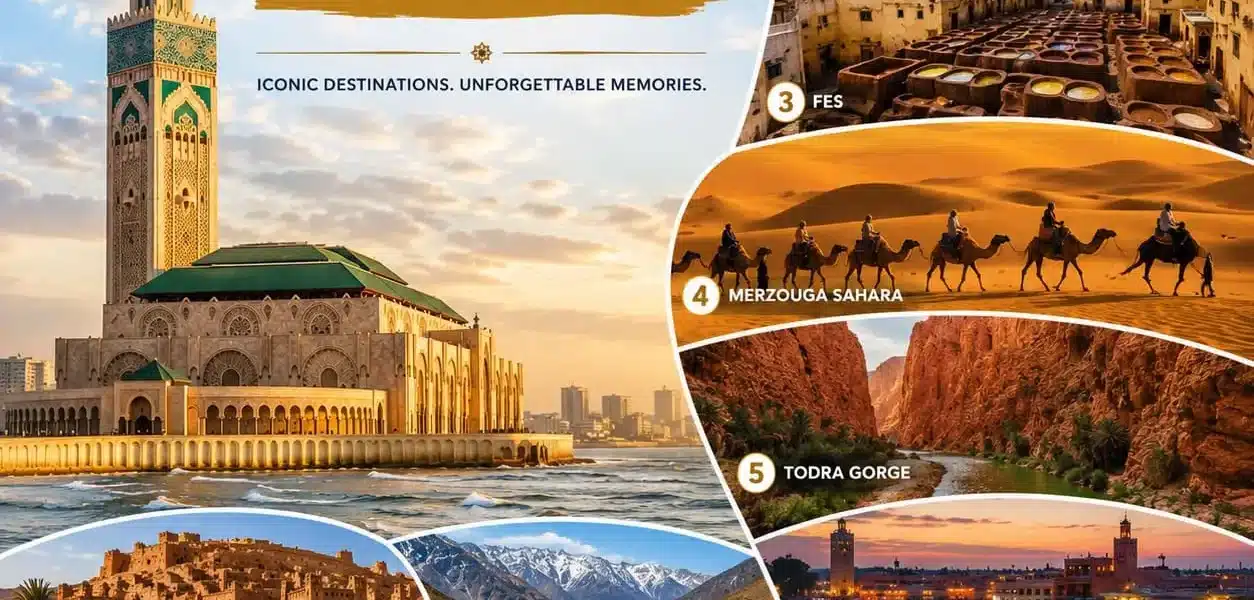
Morocco Destination Guide ✦ 2026
8 Best Places to Visit on Casablanca Tours (2026 Travel Guide)
A Morocco route out of Casablanca collects a mosque built over the Atlantic, a blue mountain town, a medieval medina, a dune sea, a 300 metre gorge, a UNESCO kasbah, two mountain ranges and a souk city. Here is what each one actually gives you, and how long to spend there.
Ask ten travellers what they want from Morocco and you get roughly the same answer in different words: the desert, an old medina, mountains, and somewhere blue for the photographs. What surprises most people is how neatly those things line up if you start on the Atlantic coast. The eight destinations below are not a wish list. They are the actual stops on the route we drive most weeks of the year, in the order the geography puts them.
We have written this the way we brief our own guests. For each place you get what it is, why it earns its day, the hour to arrive, what to skip, and how much time is genuinely enough. There is a distance table, a season table and four ready-made itinerary shapes at the end. If you want to see the finished routes first, they live on our Casablanca Tours page.
Starting point
Why Start a Morocco Tour from Casablanca?
Because the map rewards it. Casablanca sits roughly halfway up Morocco’s Atlantic coast, which puts the northern half of the country within a comfortable drive on your second day and the southern half in front of you after that. A route from Casablanca can run north to the Rif, east across the Middle Atlas into the Sahara, then west through the gorges and over the High Atlas into Marrakech without repeating a single road.
Start in Marrakech and you face a choice: an out-and-back desert loop, or a long repositioning drive to reach Chefchaouen and Fes. Both cost you a day you would rather spend walking somewhere.
The second reason is flights. Mohammed V International Airport, CMN, is Morocco’s main long-haul hub. Travellers from the United States and Canada often find it is the only direct option. From the UK, Ireland and Europe the schedules are denser and the fares usually lower than flying into Marrakech or Fes. Australian travellers connecting via the Gulf or Europe almost always route through it too.
Book an open-jaw ticket into Casablanca and home from Marrakech. It rarely costs more and it removes a three hour backtrack on your last day. If your ticket is a straight return into Casablanca, we simply drive you back at the end, or reverse the route so you finish where you started.
The gateway argument
What Makes Casablanca the Perfect Gateway to Morocco?
Three things, in order of how much they matter.
It gives you a real arrival day
Long-haul arrivals are messy. Bags go missing, connections slip, and a route that opens with a seven hour drive on the morning you land is a route that starts badly. Casablanca lets you land, sleep, see something extraordinary and begin properly the next morning. On every itinerary we run from here, that buffer is the design decision guests thank us for most.
It is a genuine destination for an afternoon
Casablanca is a working commercial city of around three and a half million people rather than a medina city, and it is worth being honest about that. What it has is the Hassan II Mosque, one of the largest concentrations of 1920s and 1930s Art Deco architecture anywhere in the world, the Habous quarter, and a coastline the city actually uses. One afternoon and one evening is the right allocation. Three days is not.
It sets up the route’s rhythm
The eight destinations on our Casablanca Tours alternate between cities and landscapes, which is what keeps a two week trip from blurring. Mosque, blue town, medina, dunes, gorge, kasbah, mountains, souks. Nothing repeats, and no two consecutive days feel the same. That sequence only works cleanly from the coast.
The route
Map of the Destinations
Here is the shape of it. The line runs north from Casablanca into the Rif, east and south into the Sahara, then west across the mountains to Marrakech. Zoom in to see the individual stops and the roads between them.
The destinations
The 8 Best Places to Visit on Casablanca Tours
Before the detail, here is the whole set side by side. Use this to work out which places deserve your limited days.
| Destination | What it is | Best for | Time needed | Best hour to arrive |
|---|---|---|---|---|
| Hassan II Mosque | Oceanfront mosque, Casablanca | Architecture, arrival day | 2 hours | Late afternoon |
| Chefchaouen | Blue mountain town, Rif | Photography, slow walking | 1 full day | Before 9am or after 5pm |
| Fes | Medieval medina, imperial city | Culture, craft, food | 1 to 2 days | Morning, with a guide |
| Merzouga | Erg Chebbi dune sea, Sahara | The desert night, stargazing | 1 to 2 nights | Late afternoon |
| Todra Gorge | 300m limestone canyon | Short hikes, dramatic scenery | 1 to 2 hours | Late morning |
| Ait Ben Haddou | UNESCO earthen ksar | History, film locations | 2 to 3 hours | Early morning or 4pm |
| Atlas Mountains | Rif, Middle and High Atlas | Views, Berber villages | Crossed over 2 to 3 days | Any daylight hour |
| Marrakech | Souk city, imperial capital | Shopping, palaces, energy | 1 to 2 days | Palaces at 9am, square at dusk |
01 Hassan II Mosque, Casablanca
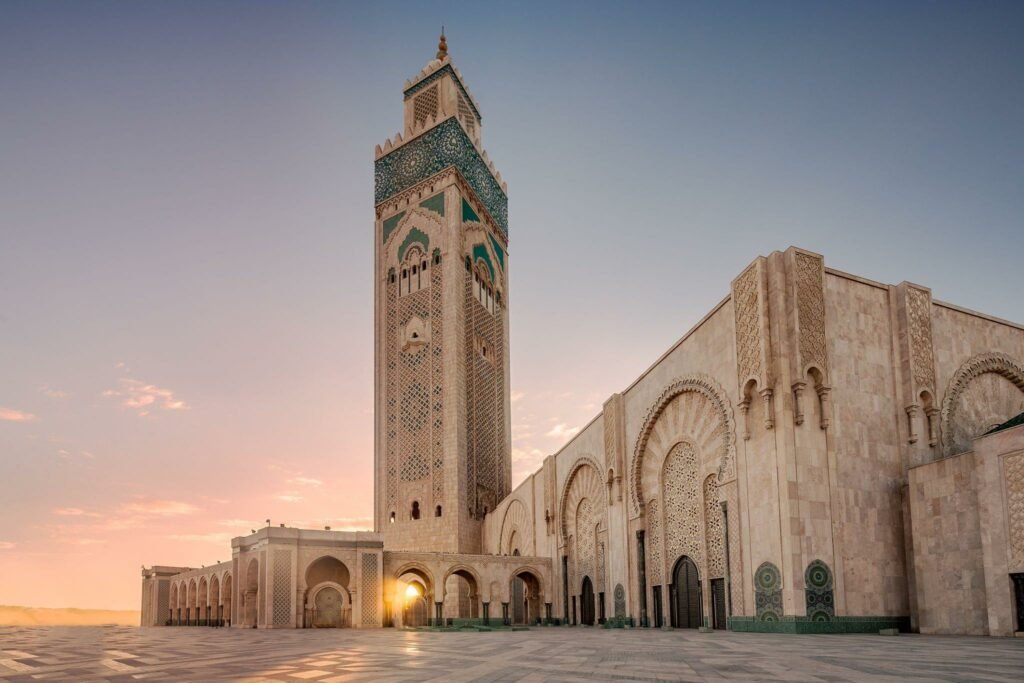
You will see the minaret before you see anything else in Casablanca. At 210 metres it is among the tallest in the world, and it stands on a platform that reaches out over the Atlantic, so at high tide the sea is directly beneath part of the prayer hall. This is the only mosque in Morocco that non-Muslim visitors may enter, which makes it a rare opportunity rather than just a photo stop.
History
Commissioned by King Hassan II and completed in 1993, it took roughly seven years to build and drew on the work of thousands of Moroccan craftsmen. The materials were sourced almost entirely within the country: cedar from the Middle Atlas, marble from Agadir, granite from Tafraout. The intention was explicit, to build something on the water because of a line in the Quran describing God’s throne upon the water.
Highlights
- The main prayer hall, which holds tens of thousands of worshippers under a retractable cedar roof.
- Hand-carved cedar ceilings and zellij tilework at a scale you will not see again on the route.
- The hammam and ablution level below, usually included on the guided visit.
- The vast open esplanade, which is where locals gather in the evening.
Best time to visit
Interior access is by guided tour only, on set times that shift with prayer schedules, the season and Ramadan. Late afternoon is the sweet spot: the western facade faces the ocean and takes the light beautifully, and you can walk the Corniche afterwards for dinner. Fridays have reduced visiting hours.
Photography tips
Shoot from the northern side of the esplanade for the classic minaret and ocean composition. Bring a wide lens for the interior, where the ceiling is the subject and a standard lens will not hold it. Sunset from the seawall, with the mosque backlit, is the frame most people come for and almost nobody plans for.
Nearby attractions
The Corniche at Ain Diab for seafood, the Art Deco streets around Boulevard Mohammed V, the Habous quarter for its bookshops and pastry stalls, and Rick’s Café if you want the film association, though the film itself was shot on a California backlot.
02 Chefchaouen, the Blue City
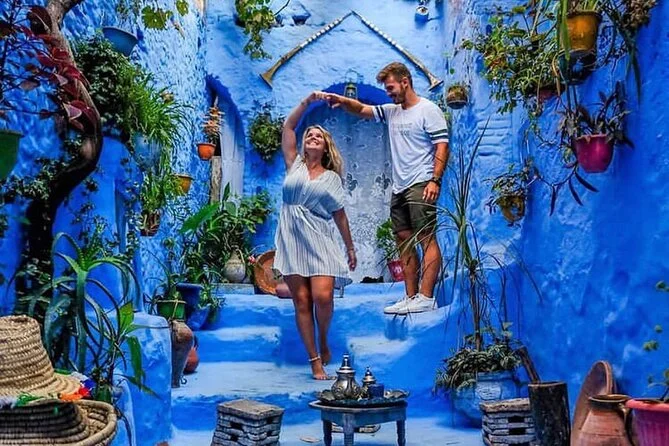
Chefchaouen is a small town in the Rif Mountains where almost every wall, step and doorframe is painted some shade of blue. Founded in 1471, it spent centuries closed to outsiders and still feels apart from the rest of Morocco: cooler air, a slower pace, mountain light. It is the one stop on this route that travellers consistently wish they had given more time.
The blue medina
The colour has several competing explanations. The most commonly repeated is that Jewish refugees who settled here in the 1930s brought the tradition of blue as a symbol of the sky. Others will tell you it repels mosquitoes, or simply that it keeps houses cool. Locals repaint by hand each year, which is why the shades vary from lane to lane, and why the town looks nothing like a preserved museum piece.
Things to do
- Walk the medina before 9am, when the lanes belong to cats, bread deliveries and residents.
- Visit the fifteenth century kasbah and its gardens on Outa el Hammam square.
- Watch weavers at work. Chefchaouen wool blankets are made here rather than imported, and the workshops welcome visitors without pressure.
- Climb to the Spanish Mosque on the hill east of town, a twenty five minute walk, for sunset over the whole blue medina.
- Hike toward the Akchour waterfalls if you have a spare half day and decent shoes.
Best photo spots
The stepped alley off Rue Bin Souaki with its potted plants is the frame that fills Instagram, and it is busy from mid-morning. Better options: the lanes below the kasbah at first light, the doorway arches on Callejón El Asri, and the panorama from the Spanish Mosque an hour before sunset. Ask before photographing people, and expect a polite no from some older residents.
The entire case for sleeping in Chefchaouen rather than passing through is timing. Between roughly 11am and 4pm, coaches from Tangier and Fes fill the photogenic streets. Before and after that window it is a quiet mountain town. This single fact is why a longer itinerary is worth the money here.
03 Fes, the Medieval Medina
Fes is the oldest of Morocco’s imperial cities and the one that changes how people think about the country. Founded in the eighth century, it has been a centre of learning, craft and religion for well over a thousand years, and unlike much of Morocco it has not been softened for visitors. It is intense, disorienting and, for a lot of our guests, the highlight of the whole trip.
The ancient medina
Fes el Bali is the largest car-free urban area in the world. Roughly nine thousand lanes, no vehicles, and donkeys still carrying goods through alleys too narrow for anything else. You will get lost. Everybody does. This is the one destination on the route where we insist on a licensed local guide, not because the medina is dangerous but because without one you will spend your day navigating rather than looking.
Within it: Al Quaraouiyine, founded in 859 and widely described as the oldest continuously operating university in the world; the Bou Inania and Al Attarine medersas, with carved cedar, stucco and zellij worth twenty minutes each on their own; the Nejjarine fountain and its woodwork museum; and the ornate Blue Gate at Bab Boujloud, which is where most visits begin.
Traditional tanneries
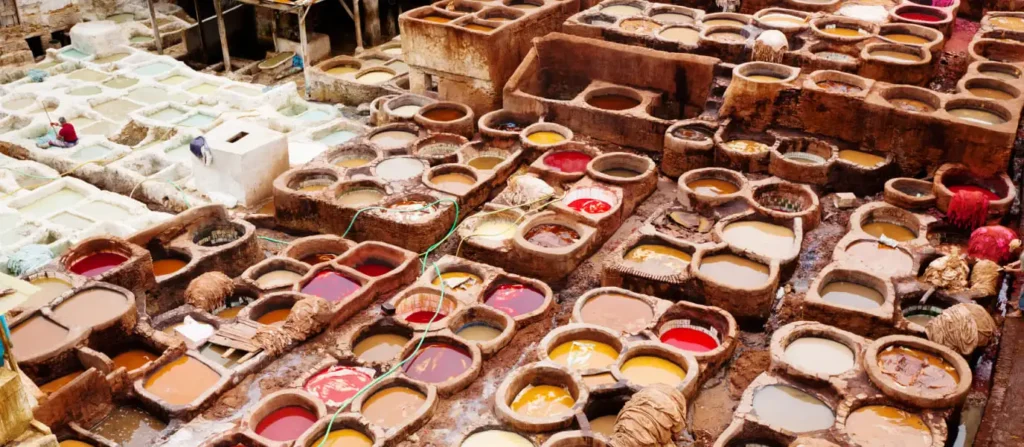
The Chouara tannery is the image people associate with Fes: stone vats of dye in ochre, red and white, worked by hand exactly as they were centuries ago. You view it from the terraces of the leather shops that surround it, and you will be handed a sprig of mint at the door, which you will want. The smell is real. Go in the morning, when the light reaches down into the vats and the work is underway. Afternoon light leaves half the courtyard in shadow.
Nobody is obliged to buy anything. If you do want leather, this is the place on the route where quality is highest and where bargaining is expected as a normal, friendly transaction.
Cultural experiences
- A cooking class in a riad, which in Fes usually starts with the market rather than the kitchen.
- Ceramic workshops in the Ain Nokbi quarter, where the blue Fassi pottery is thrown, glazed and hand-chipped into mosaic.
- Brass and copper hammering in Place Seffarine, which you hear before you find.
- A traditional hammam, which is a genuinely local ritual rather than a spa treatment.
Two nights is our standard recommendation. One night is workable. Half a day does not justify the drive.
04 Merzouga and the Sahara Desert
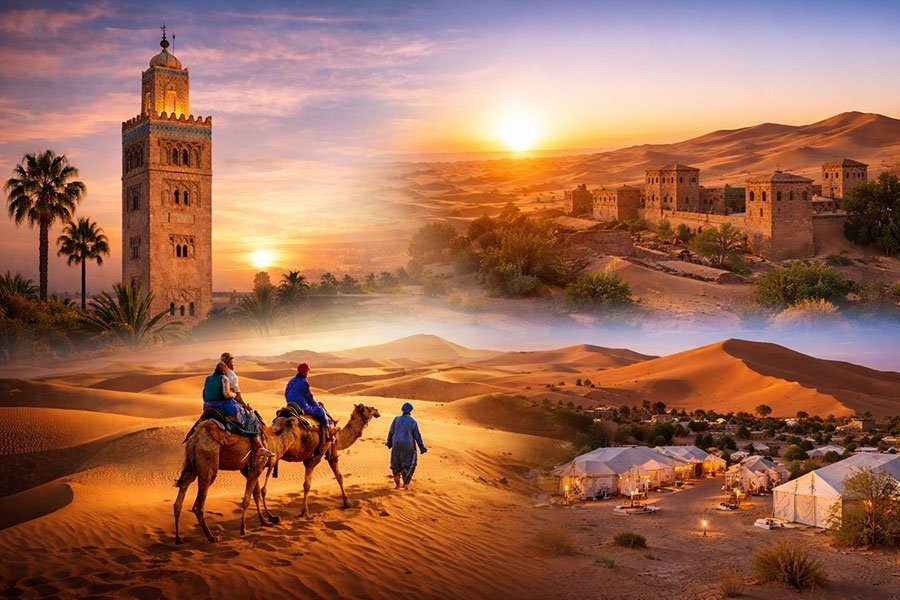
Merzouga is the village at the edge of Erg Chebbi, a dune sea with crests reaching around 150 metres that rises out of flat stony desert with almost no warning. For most travellers this is the reason the trip exists, and it is the one destination that reliably exceeds expectations rather than meeting them.
The camel trek
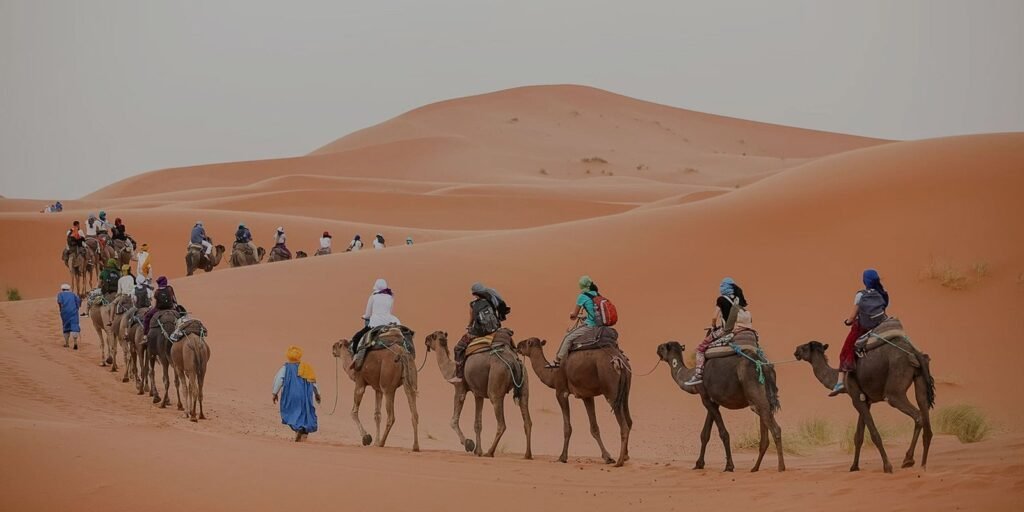
The classic arrival is by camel in the late afternoon, roughly ninety minutes into the dunes, reaching camp as the light goes gold. It is slower and more uncomfortable than people imagine, and that is part of it. If a camel is not right for you, for reasons of back, hip, pregnancy or simple preference, we drive guests to camp by 4×4 instead and nobody thinks anything of it. You still get the sunset, from a dune rather than a saddle.
Wear long trousers, closed shoes and a scarf. Take a small overnight bag only. Your main luggage stays with the vehicle and meets you the next morning.
The desert camp
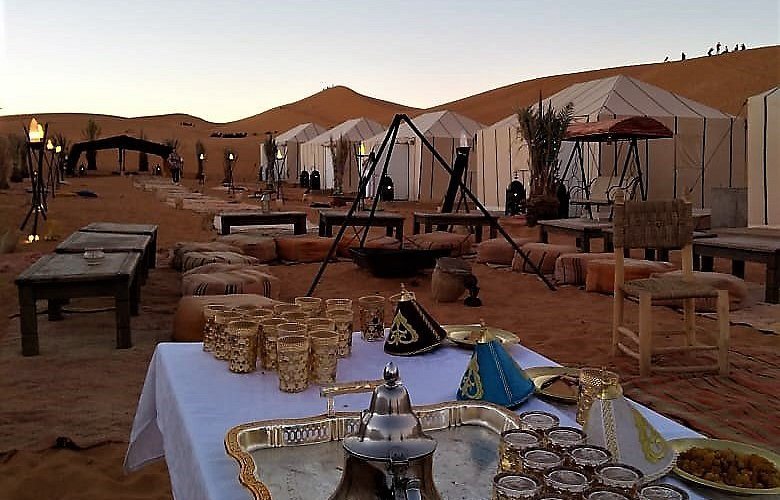
Camps sit on a spectrum. A standard camp means Berber tents, a shared bathroom block, rugs, a communal dinner and drumming around the fire. A luxury camp means an en-suite tent with a real bed, hot water, lanterns and a private terrace facing the dunes. The gap in comfort is significant, and it matters most between November and February, when nights are cold.
Dinner is usually tagine and soup cooked on site, followed by Berber music around a fire. The stargazing is not marketing language. With no light pollution for a hundred kilometres, the Milky Way is visible to the naked eye on any clear night, and the camp lanterns go out early precisely so you can see it.
Sunrise and sunset
Sunset is the arrival, when the dunes shift from yellow through orange to deep red and the ridgelines sharpen. Sunrise is the better of the two and the one people nearly miss. Climb the dune behind camp about thirty minutes before first light. The sand runs grey, then pink, then gold, and the wind pattern from the night before is still perfectly intact until the first footprints cross it.
One night gives you both. Two nights gives you a full free day in the desert: Gnaoua musicians in the village of Khamlia, mint tea with a nomad family, the fossil beds around Erfoud, sandboarding, and a second sunrise. If the Sahara is your main reason for coming, book the second night.
05 Todra Gorge
Leaving the Sahara, the road follows palm groves west and then turns north into a crack in the High Atlas. Todra Gorge is a limestone canyon whose walls rise around 300 metres on either side of a river bed that narrows to about ten metres at its tightest point. Driving into it is genuinely startling, because the temperature drops and the sky becomes a strip.
Hiking
You do not need to be a hiker. The floor of the gorge is flat, shaded and walkable in ordinary shoes, and an hour there and back covers the dramatic section. If you want more, a marked trail climbs the eastern side toward the plateau and gives a view down the length of the canyon in about ninety minutes. Rock climbers come here for the bolted routes on the west wall, and watching them is part of the entertainment.
Go late morning. Early and the gorge floor is in full shadow, late and the tour groups from Marrakech have arrived.
Berber villages
The approach through Tinghir is as good as the gorge itself. The palmeraie here runs for kilometres, an unbroken green ribbon along the river with earthen villages built up the slopes on either side. These are working agricultural communities, not display villages: date palms, alfalfa, small irrigation channels that have been maintained collectively for centuries.
If your driver offers to stop at a village rather than at the gorge car park, say yes. That is where the interesting hour is.
Scenic landscapes
Todra pairs naturally with the Dades Valley, an hour and a half west, where rose-coloured rock formations locals call the monkey fingers rise beside the road and the Dades gorge road climbs in a set of switchbacks that has become one of the most photographed stretches of tarmac in Morocco. Most itineraries do both on the same day and overnight in a kasbah hotel in the Dades.
06 Ait Ben Haddou
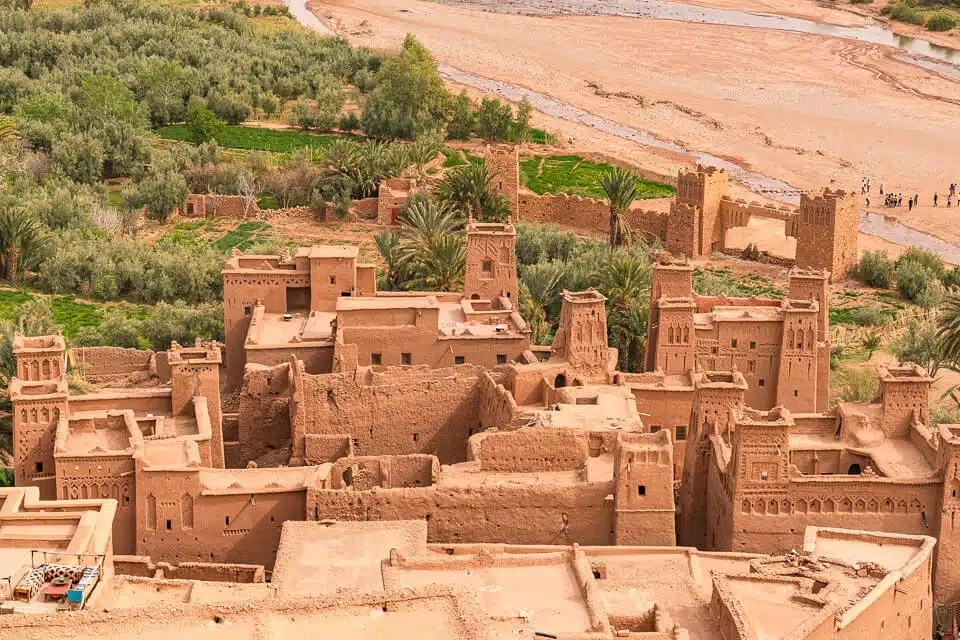
A ksar is a fortified village, and Ait Ben Haddou is the finest surviving example in Morocco: earthen towers and kasbahs stacked against a hillside above the Ounila river, with a granary at the summit. It has been a UNESCO World Heritage site since 1987 and you will recognise it long before you are told why.
Kasbah history
The ksar sat on the caravan route that carried salt, gold and slaves north from the Sahara toward Marrakech, and its defensive shape follows from that: a single fortified entrance, high blank walls, communal granary at the top. Most of the standing buildings date from the seventeenth century onward, though the site has been occupied far longer. Around half a dozen families still live inside; most of the community moved to the modern village across the river decades ago.
The construction is pisé, rammed earth mixed with straw, which is why the whole ksar is the same colour as the hill it stands on and why it needs constant maintenance. After heavy rain, sections have to be rebuilt by hand.
Movie locations
It has stood in for ancient Egypt, Jerusalem, Rome and half a dozen invented worlds. Lawrence of Arabia, The Man Who Would Be King, The Last Temptation of Christ, The Mummy, Gladiator, Kingdom of Heaven and Game of Thrones have all shot here or nearby. Twenty minutes down the road, Ouarzazate holds the Atlas Studios, which you can tour if the film history interests you and skip without regret if it does not.
Visiting it well
Cross the river on the stepping stones or the footbridge, climb to the granary at the top for the valley view, and come down through the lanes rather than the way you went up. Allow two hours, three if you want the summit at a slow pace.
Timing is everything here, exactly as in Chefchaouen. Coach groups arrive from Marrakech in the late morning. Arrive before ten or after four and you will have long stretches of it to yourself. On a two week route we overnight across the river, which lets you walk over at dawn with nobody else on the hill.
07 The Atlas Mountains
A Casablanca route crosses three separate mountain systems, and travellers often do not realise they are distinct. The Rif in the north is green, wooded and Mediterranean. The Middle Atlas is cedar forest and alpine meadow. The High Atlas is bare rock, snow in winter and the highest peaks in North Africa. Each one changes the weather in the car within an hour.
Panoramic views
The two crossings that matter are the Middle Atlas between Fes and the desert, and the High Atlas on the final approach to Marrakech. The first takes you through Ifrane, an alpine-looking town built in the 1930s and nicknamed the Switzerland of Morocco, then into the cedar forest near Azrou where troops of wild Barbary macaques live beside the road. Do not feed them, however tempting. It makes them aggressive toward the next group.
The second is the Tizi n’Tichka pass, Morocco’s highest major road at over 2,200 metres, which climbs in long switchbacks with viewpoints at nearly every bend. It is the single best drive on the route.
Berber culture
The Atlas is where Amazigh culture is most visible: villages of the same earth as the slopes they sit on, terraced fields, walnut and almond groves, communal granaries, and a language that is not Arabic. Most of our own drivers and guides come from these valleys. A lunch stop in a High Atlas village on the Tizi n’Tichka is standard on our routes and is usually where the best conversations of the trip happen.
If you want to walk in the mountains rather than drive through them, the Ourika Valley and Imlil are both within a couple of hours of Marrakech, and Imlil is the trailhead for Toubkal, North Africa’s highest peak at 4,167 metres. Either works as a day trip on a longer itinerary.
Mountain passes, practically
The roads are paved and in good condition, but they wind. Anyone prone to motion sickness should sit in the front and take something before the climb begins rather than halfway up. In winter, snow occasionally closes the Tizi n’Tichka for a few hours; there is a tunnel section now that has made closures far rarer. Temperatures at the pass can be fifteen degrees below what you left in the valley, so keep a layer within reach rather than in the boot.
08 Marrakech
Marrakech is where most Casablanca routes end, and it is the destination that suffers most from being rushed. Founded in 1070, it has been a Berber trading capital, an imperial seat and, more recently, the city that everyone photographs. It is loud, hot, theatrical and enormously enjoyable if you sequence the day correctly.
Jemaa el Fna
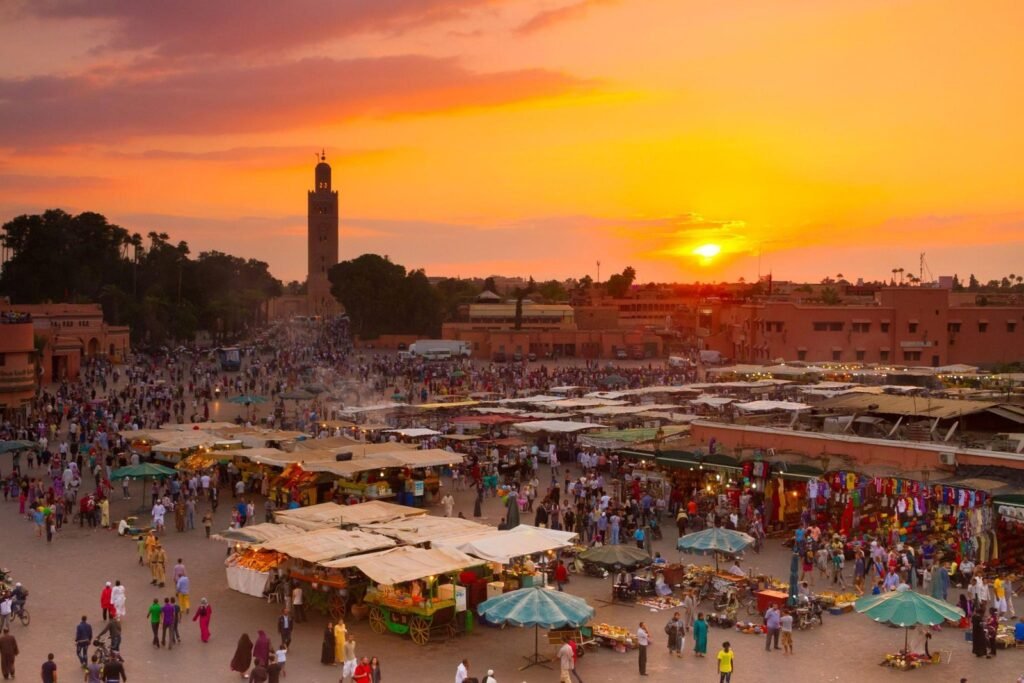
The main square is a UNESCO-recognised piece of intangible cultural heritage rather than a monument, which is an odd designation until you stand in it. By day it is orange juice carts and snake charmers. From roughly six in the evening it fills with food stalls, storytellers, musicians and crowds, and it becomes one of the great public spaces anywhere.
Here is the sequencing advice we give every guest. Eat on a terrace overlooking the square first, so you can see its shape and rhythm from above. Then walk down into it. Doing it the other way round is how people end up overwhelmed rather than delighted.
Majorelle Garden
Created by the French painter Jacques Majorelle from the 1920s and later restored by Yves Saint Laurent and Pierre Bergé, the Jardin Majorelle is two and a half acres of bamboo, cactus and water features built around a cobalt blue villa. The Yves Saint Laurent Museum sits next door and the Berber Museum is inside the garden itself.
It is popular and it feels it. Book tickets in advance for a slot before ten in the morning, or accept a queue. It is the best antidote in Marrakech to a heavy morning in the souks, which is exactly how we schedule it.
The souks
The souks north of Jemaa el Fna are organised loosely by trade: leather in one quarter, metalwork in another, then dyers, carpets, slippers and spices. Bargaining is normal and friendly. A reasonable approach is to start around forty percent of the opening price and settle near the middle, and to remember that if you are happy at the final figure, it is a fair price regardless of what anyone else paid.
Beyond the square: the Bahia Palace with its painted cedar ceilings, the Saadian Tombs, the ruins of El Badi, the Koutoubia minaret that orients the whole medina, and the Ben Youssef Medersa, which is the most beautiful interior in the city. A full guided day covers the palaces and the souks; a second day lets you add the garden, a hammam, or a day trip to the Ourika Valley or the Agafay stone desert.
A useful look at the Merzouga desert leg, which is the section travellers ask about most.
Logistics
Distances from Casablanca and How Long to Stay
Morocco is larger than it looks on a map. These are real door-to-stop driving estimates including the detours and photo stops we build in, measured from Casablanca along the route rather than as the crow flies.
| Destination | Distance from Casablanca | Driving time from previous stop | Recommended stay |
|---|---|---|---|
| Hassan II Mosque | In the city | Airport transfer, 40 min | 2 hours, plus one night in Casablanca |
| Chefchaouen | 340 km | 5 to 5.5 hrs via Rabat | 1 to 2 nights |
| Fes | 295 km direct, 630 km via the north | 4.5 to 5 hrs from Chefchaouen | 2 nights |
| Merzouga | 560 km direct, 1,100 km via the route | 7 to 8 hrs from Fes | 1 to 2 nights |
| Todra Gorge | Via Merzouga | 3 to 3.5 hrs from Merzouga | 1 to 2 hours |
| Ait Ben Haddou | Via Dades | 3.5 to 4 hrs from Dades | 2 to 3 hours, or 1 night |
| High Atlas, Tizi n’Tichka | On the road to Marrakech | 1.5 hrs from Ait Ben Haddou | Half a day of driving with stops |
| Marrakech | 240 km direct | 4 hrs from Ait Ben Haddou | 1 to 2 nights |
The Fes to Merzouga leg is about 470 kilometres and takes seven to eight hours with stops. No operator can shorten it, and you should be sceptical of anyone quoting five. What a good route does instead is break it properly: Ifrane, the macaques at Azrou, lunch in Midelt and the Ziz Valley viewpoint turn a long transfer into a day with four distinct stops.
Timing
Best Season to Visit These Destinations
Because this route crosses coast, mountains and desert, no single month is perfect everywhere. The table below is what each season actually delivers at the eight stops.
| Season | Cities and medinas | Sahara and gorges | Mountains | Verdict |
|---|---|---|---|---|
| March to May | 18 to 27°C, very comfortable | Warm days, mild nights | Green, wildflowers, passes open | Best overall. Rose harvest in the Dades in May. |
| June to August | Hot inland, cool on the coast | Over 40°C, camel rides at dawn and dusk only | Pleasant at altitude | Workable with early starts and long midday breaks. |
| September to November | 20 to 28°C, clear light | Warm days, cooling evenings | Stable weather, excellent visibility | Equal best, and our own preferred window. |
| December to February | 12 to 18°C, some rain | Pleasant days, near-freezing nights | Snow on the High Atlas | Quietest and cheapest. Pack a real winter layer. |
Check the Ramadan dates for your travel year before you book. Sites, transport and tours run normally and hospitality does not diminish, but daytime restaurant options outside hotels shrink, and the atmosphere after sunset is one of the most memorable things you can experience in Morocco. Plenty of our guests choose it deliberately.
Route shapes
Best Itinerary Depending on Trip Length
Which of the eight destinations you get depends entirely on how many days you have. Here is how they distribute across the four lengths we run most often.
| Destination | 7 days | 8 days | 10 days | 14 days |
|---|---|---|---|---|
| Hassan II Mosque | Yes | Yes | Yes | Yes |
| Chefchaouen | Afternoon | Full day | Full day | Full day plus hike |
| Fes | 1 night | 1 night | 2 nights | 2 nights |
| Merzouga | 1 night | 1 night | 1 night | 2 nights |
| Todra Gorge | Brief stop | Yes | Yes | Yes, with a walk |
| Ait Ben Haddou | Afternoon | Afternoon | Afternoon | Overnight |
| Atlas Mountains | Crossed | Crossed | Crossed with stops | Crossed plus village time |
| Marrakech | Half day | 1 full day | 1 full day | 2 days |
| Also fits | Nothing extra | A proper arrival day | Volubilis and Meknes | Essaouira and the coast |
7 days: the essentials, briskly
One week reaches all three signature landscapes: imperial cities, the Sahara and the High Atlas. The compromise is depth rather than coverage. Chefchaouen gets a long afternoon, Fes gets one guided day, and Marrakech gets an arrival evening and a morning. If your leave is fixed, book it and accept the pace. Our 7 Days Morocco Itinerary shows which stops we keep and which we drop to make the week work.
8 days: the same route, unhurried
The extra day is not spent adding a destination. It buys a full day in Chefchaouen and a genuine arrival day in Casablanca, which changes the feel of the first half of the trip entirely. If you can stretch your dates by twenty four hours, this is the best possible use of them. The route detail sits on our 8 Days Morocco Tour from Casablanca page.
10 days: the version we recommend most
Ten days is where the trip stops being a highlights reel. Two nights inside the Fes medina, Roman Volubilis and Meknes as real stops rather than photo pauses, the slower southern road out of Merzouga through Khamlia and Rissani, and a complete guided day in Marrakech. Three of the ten days involve almost no driving. The full day-by-day breakdown is on our 10 Days Morocco Itinerary.
14 days: two desert nights and the Atlantic
A fortnight changes the trip qualitatively. The Sahara gets two nights, so you experience a full desert day rather than a sunset and a sunrise. Ait Ben Haddou becomes an overnight, which is the only way to see the ksar in first light with nobody there. Essaouira and the Atlantic coast come into range, and there is room for the things people usually cut. Our 14 Days Morocco Itinerary covers the full circuit.
Trying to add Tangier or the far southern dunes at Erg Chigaga to a seven day route. Both look possible on paper and both wreck the trip in practice, because the extra driving comes directly out of the days you would otherwise spend on foot. If a destination matters that much to you, add a day rather than compress the rest.
Practicalities
Travel Tips for Casablanca Tours
Packing list
You will move through three or four climates in a single week. Layers matter more than volume, and one soft bag beats two hard cases, because vehicle space is finite and medina lanes are not friendly to wheels.
| Category | Bring | Why it matters on this route |
|---|---|---|
| Clothing | Breathable long trousers, long skirts, t-shirts, one modest long-sleeved top | Sun protection and comfort in medinas and villages |
| Warm layer | Fleece or insulated jacket, even in summer | Desert nights drop around 20°C and near freeze in winter |
| Footwear | Broken-in walking shoes, sandals, closed shoes for the camel | Fes cobbles, gorge floor, sand in everything |
| Head and face | Wide-brimmed hat, sunglasses, light scarf | The scarf doubles as sand and shoulder cover |
| Sun and skin | High SPF, lip balm, strong moisturiser | Desert air is extremely dry year round |
| Health kit | Motion sickness tablets, rehydration salts, plasters, personal medication | Tizi n’Tichka and the Dades switchbacks wind |
| Tech | European two-pin adapter, power bank, headtorch | Camps run on solar or generators with limited hours |
| Money | Cash in dirham, small notes for tips | Villages, co-ops and roadside stops are cash only |
| Bags | One soft main bag plus a small daypack | The daypack is what goes with you on the camel |
| Documents | Passport valid 6 months, insurance details, printed confirmations | Signal is patchy in the desert and the gorges |
Transportation
Three of these eight destinations are effectively unreachable on public transport. Trains are excellent on the Casablanca to Rabat to Fes corridor and useless south of Marrakech. CTM and Supratours coaches are comfortable and cheap between cities but will not get you to Ait Ben Haddou, Todra or the dunes. Grand taxis, the shared Mercedes running fixed inter-town routes, are authentic and cramped.
Self-drive is viable for confident drivers, though city parking, unfamiliar road etiquette and mountain switchbacks put many people off, and you will want the full insurance waiver. The reason most visitors on a one to two week schedule use a private driver is arithmetic rather than luxury: independent transport in southern Morocco absorbs roughly a day and a half in waiting and connections.
Weather
Expect a fifteen to twenty degree swing between a mountain pass and the desert floor on the same day, and a similar drop between desert afternoon and desert night. Coastal Casablanca and Essaouira stay noticeably cooler than inland cities all summer. Rain is a winter phenomenon and mostly northern; in the south it is rare but can be sudden, and flash flooding occasionally closes gorge roads for a few hours.
Photography
- The good light is early and late, and on this route that means being in Chefchaouen before 9am, at Ait Ben Haddou before 10am or after 4pm, and on a dune thirty minutes before sunrise.
- Sand and camera gear do not mix. A simple dry bag and a lens cloth solve almost all of it.
- Ask before photographing people, particularly women and particularly in rural areas. A refusal is not hostility.
- A wide lens earns its place inside the Hassan II Mosque and the Fes medersas. A longer lens is more useful in the souks, where distance is what makes a candid frame work.
- Drones require authorisation in Morocco and are frequently confiscated at customs. Do not assume you can fly one.
Safety
Morocco is one of the safer countries in the region and receives millions of visitors a year, including a very large number of solo women. Violent crime against tourists is rare. The realistic issues are opportunistic pickpocketing in crowded medinas, overcharging, and unofficial guides who offer to show you the way and then demand payment. Licensed guides carry an official badge and are happy to show it.
Tap water is chlorinated and safe in the main cities, though most visitors drink bottled, which is what we carry in the vehicle. No vaccinations are required from the US, Canada, UK, EU or Australia. Pharmacies are excellent and widely available. Travel insurance with medical and repatriation cover is not a formality on a route that includes mountain roads and remote desert.
On dress and etiquette: shoulders and knees covered is a sensible rule for both men and women in medinas and villages, and it changes how you are treated. Beachwear is fine at riad pools and on the coast. Learn salam, shukran and la shukran. The last one, said with a smile, politely ends almost every unwanted sales approach.
People also ask
Frequently Asked Questions
What are the best places to visit on Casablanca tours?
The eight destinations that shape almost every route are the Hassan II Mosque in Casablanca, the blue city of Chefchaouen, the medieval medina of Fes, the Erg Chebbi dunes at Merzouga, Todra Gorge, the UNESCO ksar of Ait Ben Haddou, the Middle and High Atlas mountain crossings, and Marrakech. They sit in a single forward line from the Atlantic coast to the Red City, so no road is repeated.
How many days do you need to see the main destinations from Casablanca?
Seven days reaches all eight at a brisk pace. Ten days is the length we recommend most often, because it adds a full day in Chefchaouen, two nights in Fes and a complete guided day in Marrakech. Fourteen days adds a second Sahara night, an overnight at Ait Ben Haddou and the Atlantic coast at Essaouira.
How far is Chefchaouen from Casablanca?
Around 340 kilometres, or five to five and a half hours of driving with a stop in Rabat on the way. Most itineraries break the journey at the capital to see the Hassan Tower and the Kasbah of the Udayas, which turns a long transfer into a proper sightseeing day.
How long does it take to get from Casablanca to the Sahara Desert?
Nobody drives it in one day. On a northern route the desert is reached from Fes, and that leg is roughly 470 kilometres and seven to eight hours with stops. Direct from Casablanca it would be around 560 kilometres, which is why every sensible itinerary spreads the approach across several days with stops at Ifrane, the cedar forest and the Ziz Valley.
Is one night in the Merzouga desert enough?
For most travellers, yes. One night gives you a sunset camel trek, dinner and Berber music at camp, stargazing and a dune sunrise. Two nights adds a full free day in the Sahara: Gnaoua music at Khamlia, tea with a nomad family, the Erfoud fossil beds and sandboarding. If the desert is your main reason for coming to Morocco, book the second night.
What is the best time of day to visit Ait Ben Haddou and Chefchaouen?
Both are governed by coach traffic. Ait Ben Haddou is quietest before ten in the morning and after four in the afternoon, when the groups from Marrakech have gone. Chefchaouen belongs to residents before nine and after five; between eleven and four the photogenic lanes fill with day-trippers from Tangier and Fes.
Can you visit these destinations without a private tour?
Partly. Trains and coaches connect Casablanca, Rabat, Fes, Chefchaouen and Marrakech well. Todra Gorge, Ait Ben Haddou and the Merzouga dunes are effectively unreachable on public transport without losing significant time to connections. Most visitors on a one to two week schedule use a private driver for that reason rather than for comfort.
What should I pack for a Morocco tour from Casablanca?
Layers above all. You cross cold mountain passes, hot desert and cool coastal air within the same week. Bring breathable clothing that covers shoulders and knees for medinas, a genuine warm jacket for desert nights, broken-in walking shoes, a wide-brimmed hat, a light scarf for sun and blowing sand, high SPF and cash in dirham for villages and roadside stops.
Wrapping up
Conclusion
The reason these eight destinations work as a set is contrast. A mosque on the ocean, a blue town in the mountains, a medieval city you need a guide to walk, a dune sea, a canyon, an earthen fortress, two mountain crossings and a souk city. No two consecutive days feel alike, and that is what stops a two week trip from blurring into one long drive.
What decides the quality of the trip is not which places you choose, because most routes include roughly the same ones. It is timing and pace: arriving at Ait Ben Haddou before the coaches, being in Chefchaouen at seven in the morning, climbing the dune half an hour before the sun does, and leaving enough slack that the unplanned stops still fit. Those are the moments guests describe when they write to us afterwards, and none of them appear on an itinerary.
Whatever length you settle on, plan the route around the light rather than around the mileage. Everything else follows from that.
Tell us which of these you want most
Send us your arrival date, how many days you have and which of the eight destinations matters most to you. We will come back with a route built around it, realistic driving times for every leg and a clear all-in quote. Usually within two hours, from a person in Marrakech rather than a bot.
Message us on WhatsApp
Email the team
WhatsApp +212 718 785 883 · asaramoroccotours@gmail.com
Or browse the finished routes on our Casablanca Tours page.
Office: Bloc 2 N53, Hay Hassani, Menara, Marrakech, Morocco
SEO and publishing reference (delete this block before publishing)
- SEO title (52 characters)
- 8 Best Places to Visit on Casablanca Tours ✦ 2026
- Meta description (154 characters)
- Best places to visit on Casablanca tours: Hassan II Mosque, Chefchaouen, Fes, Merzouga, Todra, Ait Ben Haddou, the Atlas and Marrakech, with real local advice.
- SEO URL
- best-places-to-visit-casablanca-tours
- Focus keyword
- Best Places to Visit on Casablanca Tours
- Excerpt
- A Morocco route from Casablanca collects a mosque built over the Atlantic, a blue mountain town, a medieval medina, a dune sea, a 300 metre gorge, a UNESCO kasbah, two mountain ranges and a souk city. Here is what each of the eight destinations gives you, when to arrive, how long to stay and how they fit into a 7, 8, 10 or 14 day itinerary.
- OG title
- 8 Best Places to Visit on Casablanca Tours (2026 Travel Guide)
- OG description
- From the Hassan II Mosque to the Erg Chebbi dunes: the eight destinations worth building a Morocco itinerary around, with timings, tips and driving distances.
- Twitter title
- 8 Best Places to Visit on Casablanca Tours in 2026
- Twitter description
- Mosque, blue city, medina, dunes, gorge, kasbah, mountains, souks. The eight stops that shape every good Morocco route from Casablanca.
- Secondary keywords covered
- Casablanca Tours, Morocco Tours from Casablanca, Places to Visit in Morocco, Morocco Itinerary from Casablanca, Best Morocco Destinations, Morocco Travel Guide, Private Morocco Tours, Casablanca to Chefchaouen, Casablanca to Sahara Desert, Morocco Imperial Cities
- Internal links used
- /casablanca-tours/ (×3), /morocco-itinerary-7-days/ (×1), /8-days-tour-from-casablanca/ (×1), /morocco-itinerary-10-days/ (×1), /morocco-itinerary-14-days/ (×1)
- Embedded video
- Merzouga, Morocco 3-Day Sahara Desert Tour, youtube.com/watch?v=41kHVcgK5yE, placed directly after “The 8 Best Places to Visit on Casablanca Tours”
- Embedded map
- Your existing Google My Maps route layer (mid=1uCYuJSY8rBQHndYG3xJy9dN_RFiEW4c), the same one used on the 10 day itinerary page
Image reference
| Placement | Image URL | Alt text | Caption |
|---|---|---|---|
| After introduction | /wp-content/uploads/2026/07/casablanca-tours.webp | Best places to visit on Casablanca tours across Morocco | Every destination in this guide sits on a single forward route from Casablanca to Marrakech. |
| Destination 1, Hassan II Mosque | /wp-content/uploads/2019/10/Casablanca-4-1024×683.jpg | Hassan II Mosque in Casablanca with its 210 metre minaret above the Atlantic | Built partly over the Atlantic and the only mosque in Morocco open to non-Muslim visitors. |
| Destination 2, Chefchaouen | /wp-content/uploads/2026/07/Chefchaouen-1-1.webp | Blue washed lanes of the Chefchaouen medina in the Rif Mountains | Chefchaouen at first light, before the day-trip coaches reach the medina. |
| Destination 3, Fes | /wp-content/uploads/2026/07/Chouara-Tannery-1-1024×447.webp | Chouara tannery dye vats in the Fes medina seen from a leather terrace | Best seen in the morning when light reaches the vats. |
| Destination 4, Merzouga | /wp-content/uploads/2026/07/merzouga-desert-camp-1.jpg | Luxury Sahara desert camp among the Erg Chebbi dunes near Merzouga | The lanterns go out early so the sky can do its work. |
| Destination 5, Todra Gorge | /wp-content/uploads/2026/07/Group-Shared-Marrakech-desert-tour-scaledf-2-1024×512.jpg | Todra Gorge canyon walls and palm groves near Tinghir in southern Morocco | Where the walls close to around ten metres apart. |
| Destination 6, Ait Ben Haddou | /wp-content/uploads/2026/07/Ait-Ben-Haddou-1.webp | Ait Ben Haddou UNESCO ksar of earthen kasbahs above the Ounila river | The most filmed location in Morocco. |
| Destination 7, Atlas Mountains | /wp-content/uploads/2026/07/Marrakech-to-Merzouga.jpg | High Atlas mountain road on the Tizi n’Tichka pass toward Marrakech | The pass crosses the High Atlas above 2,200 metres. |
| Destination 8, Marrakech | /wp-content/uploads/2026/07/marrakech-3-1024×683.jpg | Marrakech medina rooftops and the Koutoubia minaret at sunset | The usual finishing point for tours that begin on the Atlantic coast. |
Publishing notes
- Move the
<title>, meta description, canonical and social tags into your SEO plugin fields rather than duplicating them in the DOM, since TourPress generates its own head. - Aggregate rating is deliberately excluded from this page’s schema. Keep it only in the central TravelAgency block sitewide.
- The Todra Gorge image is the closest match in your current media library. If you have a dedicated Todra photo, swap it in and update the alt text.
- Internal linking: this article supports the
/casablanca-tours/landing page. Add a link back from that page to this one to close the hub and spoke loop.


